What a 500 Bag Minimum Really Means at a Japanese Packer

Ask a Japanese contract packer for a minimum order and you will usually get a number of bags, not a weight. Overseas brands often read that as evasive, or as a polite way of saying no to a small project. It is neither. It tells you exactly where the cost sits, and once you understand why, it changes how you design the product.
Our number is 500 bags per order. This is what that number is made of, what it does not cover, and the three ways projects that look too small actually reach it.
目次
The minimum is a labour number, not a volume number
Filling a bag costs the same whether there are 5 grams or 500 grams in it. Somebody positions the bag, the filler dispenses a measured portion, the seal closes, the bag gets checked, it goes into a carton. The powder inside is your cost, not ours. So the unit we charge in is the bag, and the minimum we need to make a run worth scheduling is a bag count.
At USD 0.65 a bag, 500 bags is USD 325 of filling. That is roughly the point where the set up, the line time and the handling stop costing more than the job earns. It is not a judgement about your brand being too small. It is the width of the run we have to schedule either way.
The corollary is the part people like: there is no minimum on grams. A 5 g sachet is as welcome as a 500 g pouch, and nobody will tell you your fill weight is too small to bother with. The only thing we count is bags.
Three consequences people miss
Small formats get expensive, large formats get cheap
Because the rate is flat per bag, the packing cost as a share of your product flips completely depending on size. A 10 g sachet carries USD 0.65 of filling on a small amount of product. A 100 g pouch carries the same USD 0.65 on ten times the product.
| Bag size | Fill cost per bag | Fill cost per 100 g of product |
|---|---|---|
| 10 g | USD 0.65 | USD 6.50 |
| 20 g | USD 0.65 | USD 3.25 |
| 30 g | USD 0.65 | USD 2.17 |
| 50 g | USD 0.65 | USD 1.30 |
| 100 g | USD 0.65 | USD 0.65 |
If you are agonising over whether to launch at 30 g or 40 g, this table is the argument. The larger bag is almost always the better unit economics, and the reason to choose the smaller one should be the shelf price, not the packing bill.
The count is across the order, not per product
This is the part that rescues most projects that look short. 500 bags is the total we need to schedule a run. You can split it across sizes, across recipes, or both. Two hundred bags of one blend, two hundred of another and a hundred sample sachets is a valid 500. Nobody has to commit to 500 units of a single product they have not tested yet.
For a brand launching a range, that changes the whole risk profile. You can put three flavours on the shelf at 170 bags each instead of betting the order on one of them, find out which sells, and come back with a reorder weighted toward the winner.
Volume does not get you a lower rate
The per bag fill rate is the same at 500 and at 50,000. That one number does not move with quantity at all, which is unusual and worth knowing. What does move is everything charged once per order: the USD 130 set up on a first order, the USD 2.55 dispatch handling, and the USD 45 handling if you supply your own bags. Spread those across more bags and the cost per unit comes down, which is what the table shows.
| Order size | Set up cost per bag | Fill plus set up, per bag |
|---|---|---|
| 500 bags | USD 0.26 | USD 0.91 |
| 1,000 bags | USD 0.13 | USD 0.78 |
| 5,000 bags | USD 0.03 | USD 0.68 |
| Repeat order, any size | USD 0.00 | USD 0.65 |
So the real saving is not in ordering more at once. It is in ordering again. The set up fee is charged on your first order only, which means a second run of the same job is USD 130 cheaper than the first whatever its size. Splitting the year into several runs costs slightly more in total than one large one, because each shipment carries its own dispatch handling, but the gap is single figures across a year and your stock spends less time sitting.
How to compare this with anybody else’s minimum
Packing minimums are quoted in at least four different units across the industry, which makes comparison harder than it should be. Translating them into the same terms takes a minute and it is the only way to tell whether a quote is actually cheaper.
| Quoted as | What it really means | To compare, ask |
|---|---|---|
| A bag count, like ours | A number of filling operations | Nothing. This is the directly comparable one |
| A weight, like 100 kg | A volume of material | How many bags that is at my fill weight |
| A production batch | Their vessel, / their line run | How many retail units come out of one batch |
| A minimum run charge | A floor on the invoice | What that divides to per unit at my quantity |
The weight version catches people out most. A 100 kg minimum sounds modest until you work it at a 30 g retail size, where it is more than three thousand bags. The same 100 kg at a 500 g wholesale size is two hundred bags, which may be under their minimum in a different unit again.
A minimum run charge is the one worth pressing on, because it is a floor rather than a quantity. Divide it by the number of units you actually want and compare that per unit figure, not the headline.
Why a bag count is the honest unit for this work
Our costs are operations: setting a line up, running it, clearing it down, and one filling action per bag. None of that scales with how many grams go into each bag, which is why we charge the same USD 0.65 whatever the fill weight and why there is no minimum on grams at all.
A packer quoting in kilograms is pricing something whose cost does not actually behave that way, which is usually a sign that the quote contains a margin to absorb the mismatch. That is not dishonest, it is just less legible, and it makes a small order look worse than it is.
Three ways to reach 500
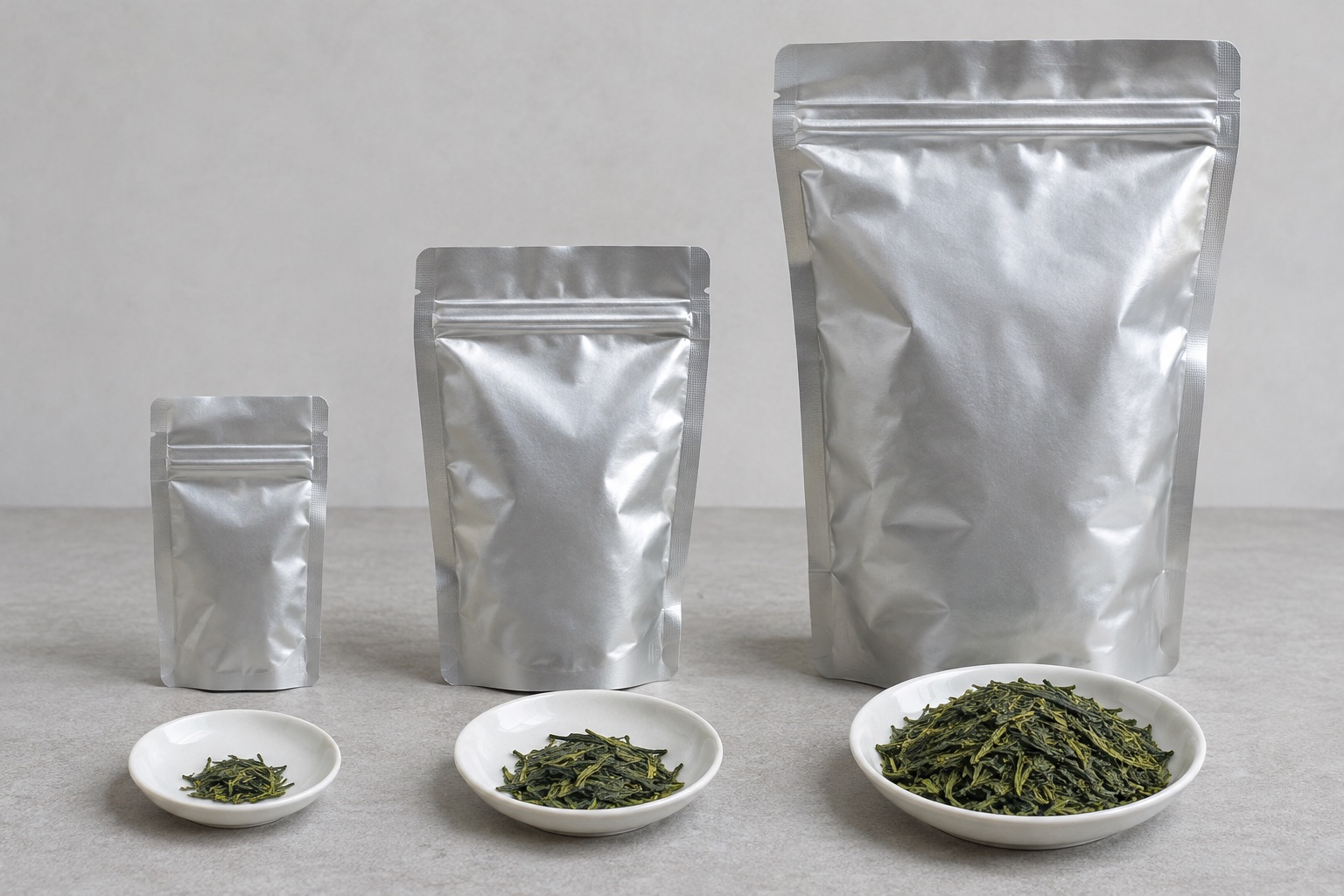
- Shrink the bag. Ten kilograms at 30 g is 333 bags. The same ten kilograms at 20 g covers 500, with no extra material bought, as long as you send a margin over the bare multiplication.
- Add a second format. A retail pouch plus a sample sachet from the same batch counts as one order, and the sachets give your sales team something to hand out.
- Add a second product. If you are already importing two teas or two powders, bag them in one run. The 500 is a total across the order, so two products at 250 bags each clears the minimum where neither of them would alone.
What does not work is promising the rest later. The 500 has to be in the order we schedule, because the run is scheduled for the quantity in front of us.
A multi format order, worked out
The most useful thing the per order count does is let one run carry several products. Here is a realistic shape for a brand launching properly rather than testing: one retail size, one larger size, and a sample.
| Line | Quantity | Bag | Cost |
|---|---|---|---|
| Retail pouch, 30 g | 250 bags | Aluminium, USD 0.30 | USD 237.50 |
| Wholesale pouch, 200 g | 100 bags | Stand pouch, USD 0.45 | USD 110.00 |
| Sample sachet, 5 g | 150 bags | Sweets pack, USD 0.10 | USD 112.50 |
| Label application, one position each | 500 positions | USD 0.15 | USD 75.00 |
| Set up fee, first order only | once | USD 130.00 | |
| Dispatch handling | one shipment | USD 2.55 | |
| Total | 500 bags | USD 667.55 |
Three products, three formats, one order, one set up fee, one shipment. Ordered as three separate runs it would be three set up fees on first orders and three lots of dispatch handling, before any extra freight.
The cost per bag varies by line here because the bags differ, which is the point: the fill rate is flat at USD 0.65 and everything else is a choice you control. A cheaper sample bag costs less than a retail pouch because it is a cheaper bag, not because the sample is easier to fill.
What the minimum does not cover
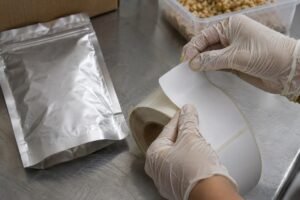
The 500 applies to filling. Everything else is priced separately, and on a first order the materials often cost more than the labour, so it is worth seeing the whole shape of the bill before you compare it with anything.
| Line | Price | Notes |
|---|---|---|
| Fill & seal, one material | USD 0.65 per bag | Any gram weight |
| Fill & seal, measured mix | USD 1.10 per bag | Several finished components weighed into one bag |
| Bags | USD 0.10 to USD 1.85 per piece | 25 stock items, plus sourcing to your spec |
| Label application | USD 0.15 per position | A back label is a second position |
| Set up | USD 130 | First order only |
| Your own materials | USD 45 per order | Flat handling charge |
| Dispatch | USD 2.55 per shipment | Freight itself at cost, separately |
| Unannounced arrival / quantity mismatch | USD 85 per case | Avoidable with a dispatch notice |
Two of those lines catch people out. The measured mix rate applies when more than one finished ingredient goes into the same bag, because that is two weighing operations. It is not blend development, which we do not do at all: you give us the grams of each component and we put exactly that in.
The other is the USD 45 for bringing your own packaging. If you want your artwork printed on the bag itself instead of applied as a label, you have to supply the bags, and that charge covers receiving, checking and staging them. At 500 bags it is nine cents a unit. At 5,000 it is under one cent, so it is rarely the thing that decides anything.
A mixed first order, priced out
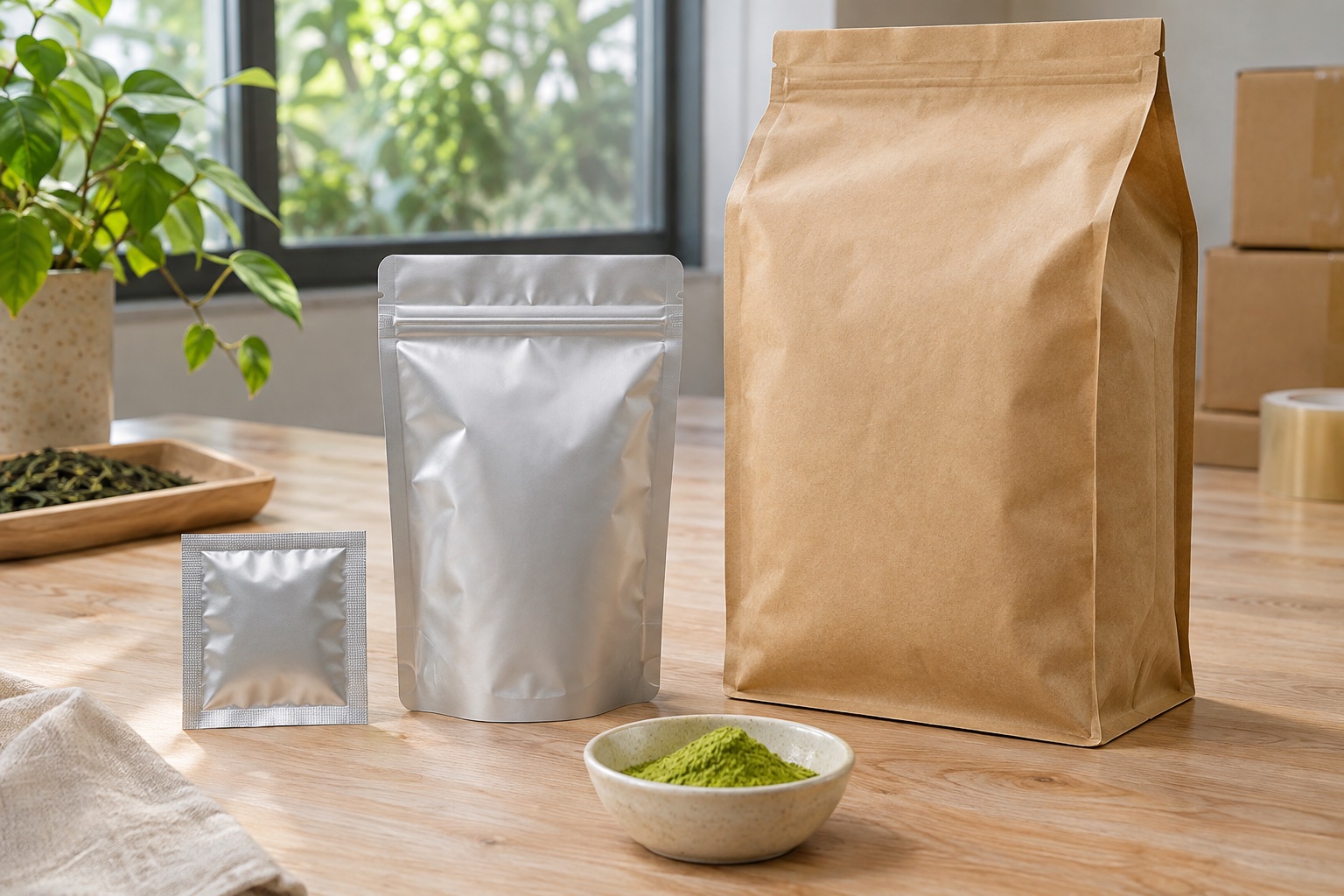
Three products in one run, 500 bags in total, our stock clear stand up pouch with a window, one label each. This is a realistic shape for a first order.
| Line | Quantity | Cost |
|---|---|---|
| Fill & seal, single material | 500 bags at USD 0.65 | USD 325.00 |
| Clear stand up pouch with zipper, 120 by 200 mm | 500 at USD 0.45 | USD 225.00 |
| Label application, one position | 500 at USD 0.15 | USD 75.00 |
| Set up, first order only | once | USD 130.00 |
| Dispatch handling | one shipment | USD 2.55 |
| Total | USD 757.55 | |
| Per bag | USD 1.52 | |
| Per bag on reorder | USD 1.26 |
Three distinct products on a shelf for under eight hundred dollars of packing, with the material cost and the freight on top. That is the number worth comparing against setting up to do it yourself.
Where the minimum is the wrong question
Sometimes a project is not blocked by the bag count at all. If you need the material dried, milled, roasted or blended to a recipe before it can be bagged, or if you need laboratory analysis, the minimum is not your problem because we do not do those steps at any quantity. What a packer will not do is the honest list, and reading it first saves a round of email.
Nitrogen flushing and vacuum sealing fall in the same category. We fill and heat seal in ambient air on every format, and stick packs are the one shape our equipment cannot run.
The short version
- 500 bags per order, counted across every size and recipe in that order.
- No minimum on grams. Fill weight is your decision alone.
- USD 0.65 per bag flat, or USD 1.10 when several finished components are weighed into one bag.
- The one time USD 130 set up is the only thing that gets cheaper with scale, so reordering beats over ordering.
- Materials, labels and dispatch are priced on top, and on a first order they are usually the larger half of the bill.
Full price list and conditions are on our contract packing page.
Questions we get asked
Is the 500 per product or per order?
Per order. Three products at 170 bags each clears it. Two formats of the same product clear it. The count is a total across everything in one run.
Is there a minimum fill weight?
No. There is no minimum on grams at all. We count bags because the cost is the filling operation, and that operation is the same whether the bag holds 5 g or 500 g.
Does the price per bag fall if I order more?
The fill rate does not move at all: USD 0.65 a bag at five hundred and at fifty thousand. What falls is anything charged once per order, chiefly the USD 130 set up fee on a first order, spread across more units.
Can I order 500 now and the rest later at the same price?
The rates are published and they do not change with quantity, so a later order is priced the same. What does not work is counting a future order towards today’s minimum. The 500 has to be in the run we schedule.
Is the set up fee charged on every order?
No. Once, on your first order with us. A repeat run of the same job is USD 130 cheaper than the first, whatever its size.
Related reading
- Matcha packing, priced out at three bag sizes
- Pack in Japan, or ship bulk and pack at home
- Stock bags and what each one costs per piece
- A packer is not a manufacturer
- How Japanese suppliers quote and get paid
Tell us the bag count and the sizes. That is enough to price it. WhatsApp reaches us fastest, and we answer in English. If you would rather not use it, the enquiry form does the same job.
Message us on WhatsApp Use the enquiry form Agriture Inc., Kyoto, Japanこの記事を書いた人
関連記事
-
 Organic, Halal, Vegan: the Claims We Cannot Certify
-
What Goes on the Label, and Who Supplies It
-
Boxed Sets and Multi Packs: the Count That Decides Everything
-
Private Label Matcha: Who Sells You the Tea, and Who Bags It
-
Hojicha Is the Easy One to Bag, and the Roast Is Why
-
Tea Filter Bags in Small Quantities, and the Arithmetic Nobody Expects
-
Pack It in Japan, or Ship It Home in Bulk and Pack It There
-
Dried Shiitake: the One Where the Customer Wants to See It