Dried Shiitake: the One Where the Customer Wants to See It

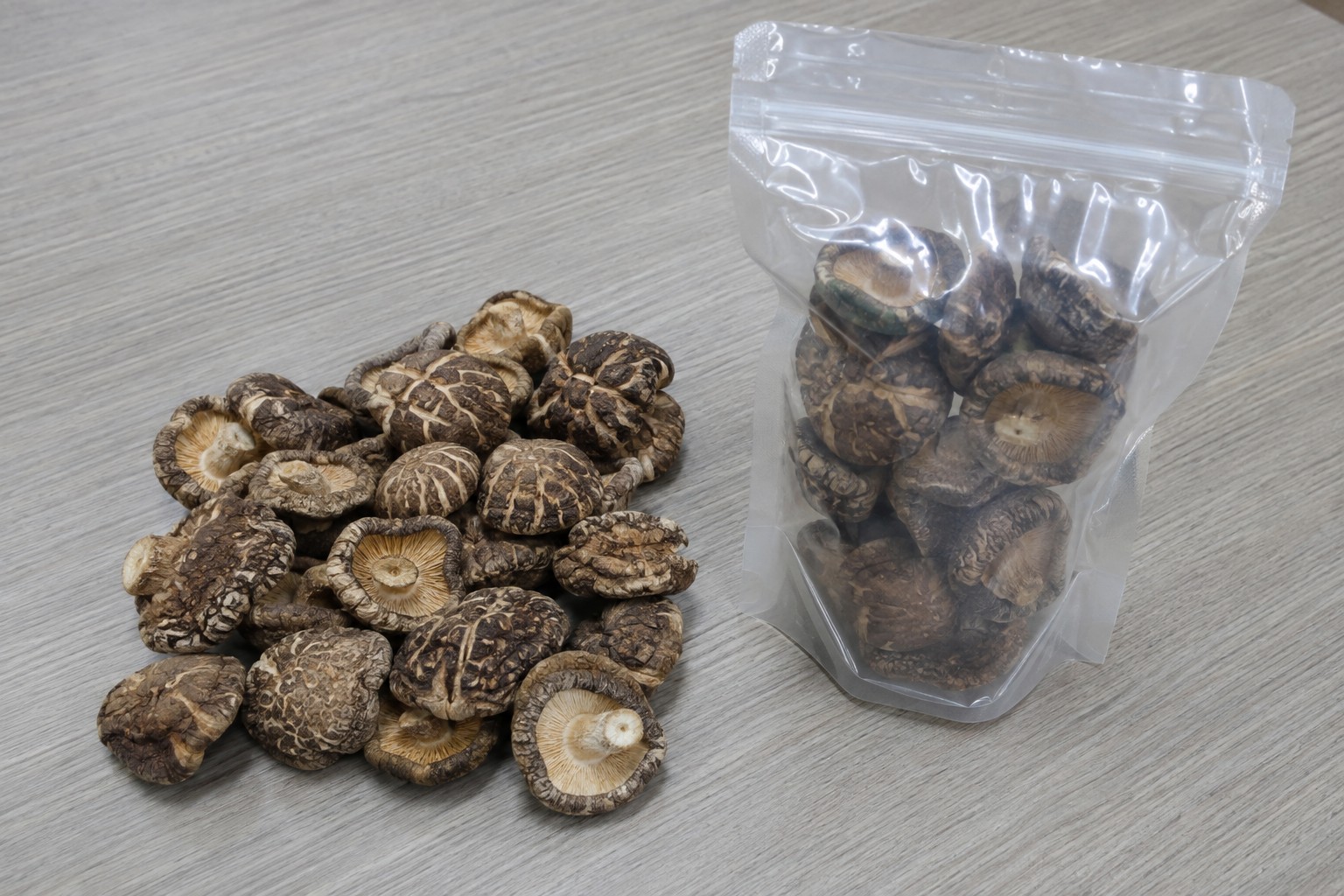
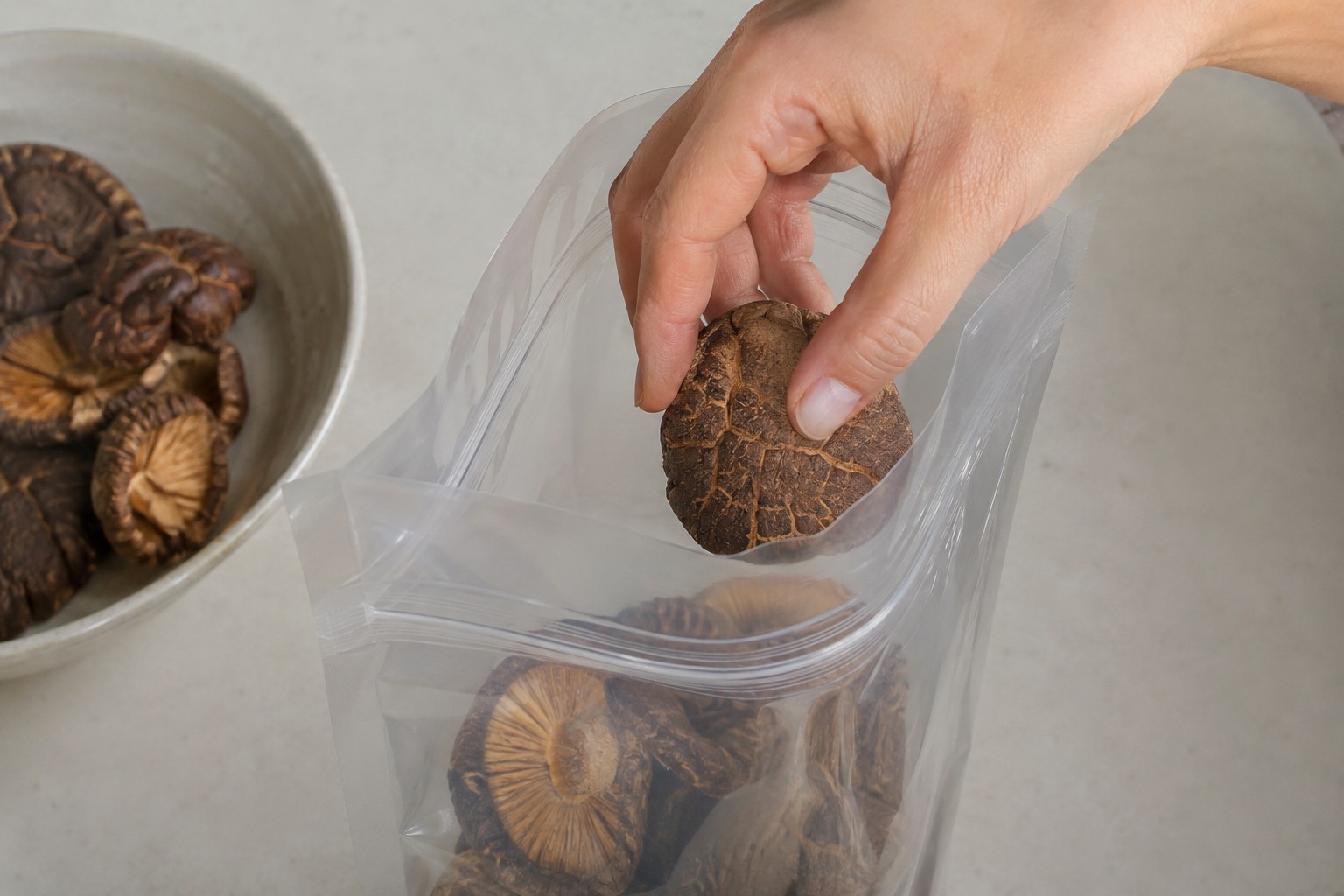
Almost everything we fill is a powder, and almost every decision about a powder bag is about keeping light out. Dried shiitake inverts that. Nobody distrusts a dried mushroom because they can see it, and hiding it behind foil throws away the best thing the product has going for it.
That single difference changes the bag, the price and the way you should think about the fill weight.
目次
Clear film is the right answer, and it is the cheap one
For a powder we usually steer people towards an opaque barrier bag. For dried pieces the argument runs the other way: the look of the contents is doing your marketing, and a window or a fully clear bag is what lets it.
Conveniently, those are also the least expensive bags we hold.
| Code | Option | Size | Per piece |
|---|---|---|---|
| PKG-015 | Clear flat pouch | 100 by 120 mm | USD 0.15 |
| PKG-017 | Clear flat pouch | 120 by 140 mm | USD 0.15 |
| PKG-007 | Clear flat pouch with zipper, light goods | 140 by 230 mm | USD 0.30 |
| PKG-008 | Clear flat pouch with zipper, light goods | 170 by 260 mm | USD 0.35 |
| PKG-001 | Clear stand up pouch with zipper, window | 120 by 200 mm | USD 0.45 |
| PKG-003 | Clear stand up pouch with zipper, window | 140 by 220 mm | USD 0.50 |
Note the two entries described as light goods. Those are the ones to look at first, because that is exactly what dried shiitake is: a lot of volume for very little weight. The complete stock list has all 25 items if none of these is right.
Volume decides the bag, not weight
This is the part that catches people who have packed a powder before. A 50 g bag of dried vegetable powder is a small object. A 50 g bag of sliced dried shiitake is not, because the slices trap air and refuse to settle.
So you cannot choose a bag from a weight. You have to choose it from the volume the product actually occupies, and the only reliable way to do that is to measure it or to send us a sample.
| Fill weight | Net material for 500 bags | What it tends to suit |
|---|---|---|
| 20 g | 10 kg | Single use, a soup portion |
| 50 g | 25 kg | The common retail size |
| 100 g | 50 kg | Family size, repeat buyers |
| 500 g | 250 kg | Food service, wholesale |
Those are net weights, meaning what ends up inside the bags. Send a margin on top, because filling to a target weight always leaves some behind. Tell us the weight you plan to ship with the bag count you want and we will confirm it before you book freight.
Whole caps, slices and powder are three different jobs
Whole dried caps are the bulkiest and the most awkward to weigh accurately, because the unit size is large relative to the target weight. Slices are the easiest of the three and the most common retail form. Powder behaves like any other fine powder, which is to say it is slow and it packs down.
Tell us which one you have in the first message. It decides whether you get a straightforward quote back, or a conversation about whether we need the material in hand first.
How to measure the volume yourself
You do not need equipment. Take a kitchen measuring jug, weigh out the fill weight you are planning, tip it in loosely without pressing it down, and read off the millilitres. Tell us that number with the weight.
Two minutes of that is worth more to a quotation than any amount of describing the product in words, and it is the single most useful thing you can send us for a bulky material. If the number comes out above about 250 ml for a retail fill weight, expect to be looking at the larger bags on the list rather than the cheapest ones.
Matching the pack size to how it gets used
Dried shiitake is not consumed in one sitting. A household rehydrates two or three caps at a time, which means your pack size is really a question about how many meals it represents and how long the bag stays open.
That points at smaller retail formats than people initially choose. A 100 g bag of dried shiitake is a lot of mushrooms and it will be open for months. A 20 g or 50 g bag gets used while it is still good, and it puts a lower number on the shelf price, which matters for a product a new customer is trying for the first time.
The counter argument is our minimum. Five hundred bags of 20 g is ten kilograms of material, which is a very small commitment, while 500 bags of 100 g is fifty. So the smaller format is usually both the better product decision and the cheaper way in. That alignment does not happen with every ingredient, and it is worth taking advantage of when it does.
What we do not do to it
We do not dry it. We do not slice it, grind it or grade it. Dried shiitake reaches our line already finished, ambient, in sealed bulk bags inside cartons, and we weigh it into retail bags.
We also hold and fill at room temperature only. There is no refrigerated or frozen handling at any point, which is not usually a constraint for a dried product but is worth stating. What a packer will not do has the full boundary, including the laboratory work we cannot run.
A worked first order
Five hundred retail bags of 50 g, our clear flat pouch with a zipper, one front label, twenty five kilograms of sliced dried shiitake from your producer.
| Line | Unit | 500 bags |
|---|---|---|
| Fill & seal | USD 0.65 per bag | USD 325.00 |
| Clear flat pouch with zipper, 140 by 230 mm | USD 0.30 per piece | USD 150.00 |
| Label application, one position | USD 0.15 per position | USD 75.00 |
| Set up fee, first order only | USD 130 once | USD 130.00 |
| Dispatch handling | USD 2.55 per shipment | USD 2.55 |
| Total, first order | USD 682.55 | |
| Per bag, first order | USD 1.37 | |
| Per bag, repeat orders | USD 1.11 |
The mushrooms themselves and the freight sit on top, and both are yours.
Two formats on one order
The 500 is a total across the order rather than per product, which opens an option that suits dried mushroom particularly well: run slices and powder in the same order.
They are genuinely different products to a customer. Slices go into a broth or a stew and the customer wants to see them. Powder goes into a seasoning blend or a sauce, and nobody needs to look at it. Selling both lets you reach two different uses from one material relationship, and on our side it is one order, one set up fee of USD 130, one shipment.
Two hundred and fifty bags of each clears the minimum. So does 400 of one plus 100 of the other. The 500 bag minimum explains how the count behaves across a mixed order, including different bag sizes in the same run.
The one thing to keep separate in your head is that the two formats want different bags. The slices want clear film so the product shows. The powder wants something opaque, for the same reasons any powder does. That is two bag lines on the quotation, not one.
Where the zipper earns its money
More than it does on most products. Dried shiitake is rarely used all at once: a household takes two or three caps at a time over weeks, which means the bag gets opened repeatedly and then has to keep the rest usable.
We fill and heat seal in ambient air, with no nitrogen flushing and no vacuum on any format, so a resealable top is the practical answer. The USD 0.15 difference across a zipper is small against a product people will be opening for a month.
What to tell us when you ask
- Whole caps, slices or powder.
- The fill weight per bag and the total bag count.
- Roughly what volume the product occupies, or send a sample.
- Whether you want a stock bag or are supplying printed bags yourself.
- The date you need finished stock in your own warehouse.
Rates, the stock list, minimums and conditions are on the contract packing page.
Questions we get asked
Can you dry the mushrooms for me?
No. Drying, slicing and grading all belong to your producer. The product reaches our line finished and ready to weigh.
Why does my 50 g bag need to be so large?
Because dried shiitake is mostly air. The slices trap space and do not settle, so the bag has to be chosen from the volume the product occupies rather than from its weight.
Should I use a clear bag or a barrier bag?
Clear, in most cases. The appearance of the product is the strongest thing you have, and clear film is also the cheapest option we hold at USD 0.15 a piece.
Can you mix shiitake with other dried vegetables?
If you send the components finished and tell us the grams of each, yes, as a measured mix at USD 1.10 a bag instead of USD 0.65. Deciding the ratio is not something we do.
Is there a minimum weight per bag?
No. There is no minimum on grams at all. The minimum is 500 filled bags across the order, and a 20 g bag counts the same as a 500 g one.
Related reading
- Stock bags and what each one costs per piece
- Rice flour, the dense one
- What a 500 bag minimum really means
- A packer is not a manufacturer
Tell us the cut, the fill weight and the bag count. A sample helps if the volume is hard to describe. WhatsApp reaches us fastest, and we answer in English. If you would rather not use it, the enquiry form does the same job.
Message us on WhatsApp Use the enquiry form Agriture Inc., Kyoto, Japan- Where Our Part Ends: the Handover in Kyoto and the Leg After It
- Rice Flour Is Dense, Which Makes It the Cheap One to Bag
この記事を書いた人
関連記事
-
 Organic, Halal, Vegan: the Claims We Cannot Certify
-
What Goes on the Label, and Who Supplies It
-
Boxed Sets and Multi Packs: the Count That Decides Everything
-
Private Label Matcha: Who Sells You the Tea, and Who Bags It
-
Hojicha Is the Easy One to Bag, and the Roast Is Why
-
Tea Filter Bags in Small Quantities, and the Arithmetic Nobody Expects
-
Pack It in Japan, or Ship It Home in Bulk and Pack It There
-
Sakura: the Form It Arrives In Decides Whether We Can Run It at All