Sakura: the Form It Arrives In Decides Whether We Can Run It at All

Sakura is the ingredient where the first question is not what it costs. It is whether we can run it at all, and the answer depends entirely on which form your producer supplies.
That is unusual. For almost everything else we fill, the form changes the bag and the price. For sakura it decides whether there is a job here or not, so it is worth settling before anything else.
目次
Salt pickled is a no, and it is not a close call
The most recognisable sakura ingredient in Japan is the salt pickled blossom, the one that unfurls in a cup of hot water. It is wet, it is salted, and it is normally kept chilled.
We hold and fill dry goods at room temperature. There is no refrigerated or frozen handling at any point on our line, and nothing wet goes through a filler built for powders and dried pieces. So a salt pickled blossom is outside our scope completely, and no amount of rearranging the order changes that.
We would rather say so in the first email than three weeks into a conversation. What a packer will not do has the rest of the boundary, and the ambient only rule is the one that rules out the most projects.
| Form | Can we fill it | Why |
|---|---|---|
| Salt pickled blossom | No | Wet, salted, usually chilled |
| Salt pickled leaf | No | Same |
| Dried petals | Yes | Dry, ambient, behaves like a light dried piece |
| Sakura powder | Yes | Dry, ambient, behaves like any fine powder |
| Sakura flavoured sugar / salt blend | Yes, if it arrives blended | Dry. We fill it, we do not make it |
The season is the narrowest we deal with
Yuzu has two harvests several months apart. Matcha has a first flush and a second. Sakura has a few weeks, once, in spring, and everything downstream of it is working from a quantity that was fixed at the moment the blossom came off the tree.
What makes that harder than yuzu is the mismatch with demand. The material exists in spring. Overseas interest in sakura products also peaks in spring, which is exactly when this season’s material has not been processed yet. The product you sell in spring was made from last year’s blossom.
Which means you are always planning a year out
Agree the quantity with your producer before the blossom, not after it. Confirm which year the material is from, because it changes what you are selling. Then work the packing dates from when the finished dried material will actually exist, rather than from when you want it on a shelf.
Our lead time is three to four weeks from the day the order is confirmed and your material has reached Kyoto. Add the Japanese factory calendar on top, because a spring run collides with the early May holidays. The three weeks when nothing ships has the windows. If you want finished stock in your own warehouse for a spring campaign, the conversation starts the previous autumn.
Dried petals are light, which sets the bag
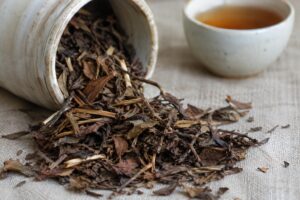
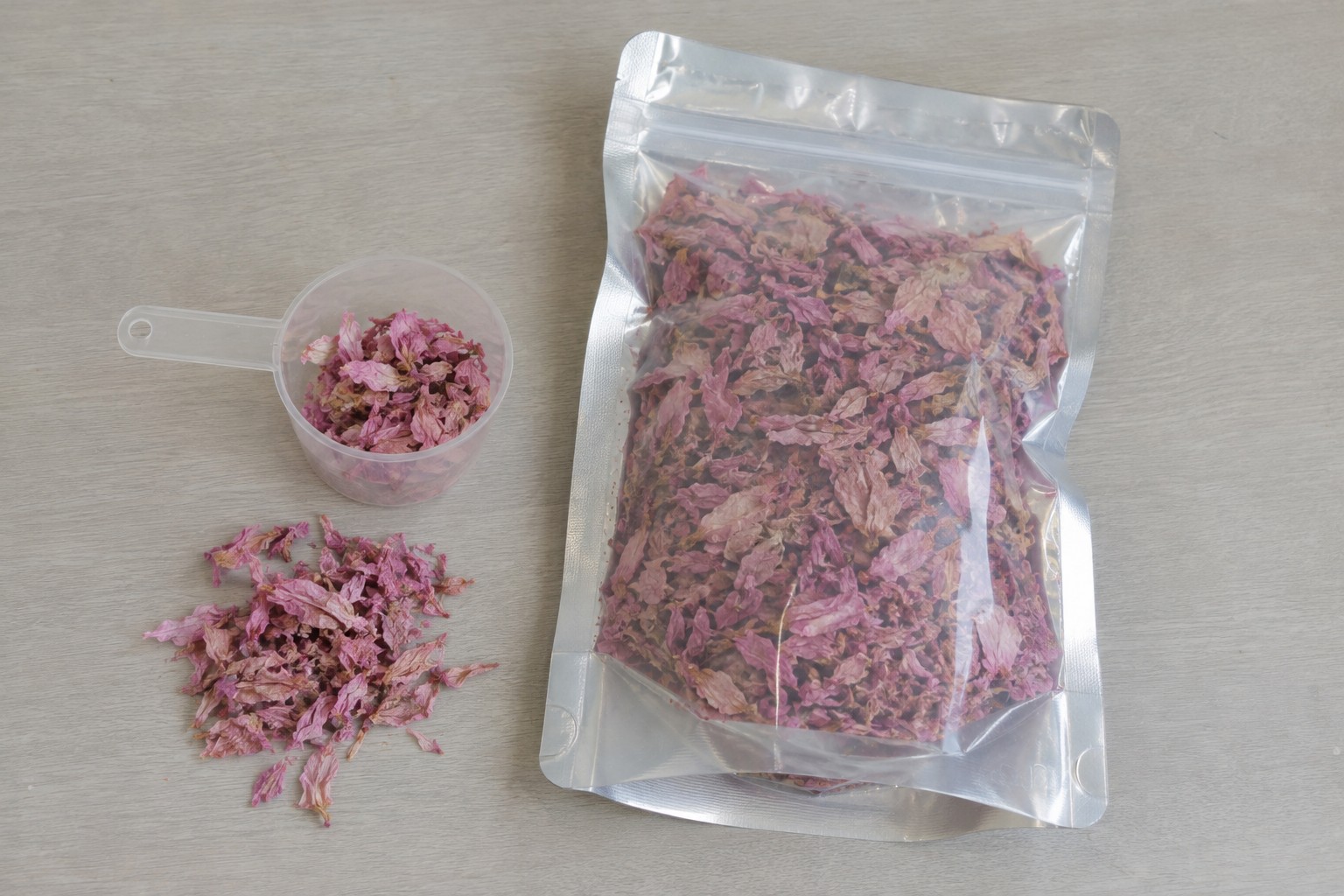
Dried blossom is extremely light for its volume, in the same way roasted tea leaf is. A retail bag of dried petals holds a very small weight in a physically large space, and the bag has to be chosen from the volume rather than from the grams.
| Fill weight | Net material for 500 bags | Notes |
|---|---|---|
| 5 g | 2.5 kg | A realistic retail size for petals |
| 10 g | 5 kg | Larger retail, / a baking pack |
| 20 g | 10 kg | Food service |
Those are net weights, so send a margin on top. Two and a half kilograms of dried petals is a complete first order, which makes sakura one of the cheapest ingredients to reach our minimum with. It is also one of the bulkiest, so tell us the volume or send a sample before you choose a bag.
For sakura powder the arithmetic works the ordinary way and the product behaves like any fine powder on the line: slower, prone to packing down, and it leaves a little of itself in the machine on every bag.
Colour is the whole product, so the bag has to protect it
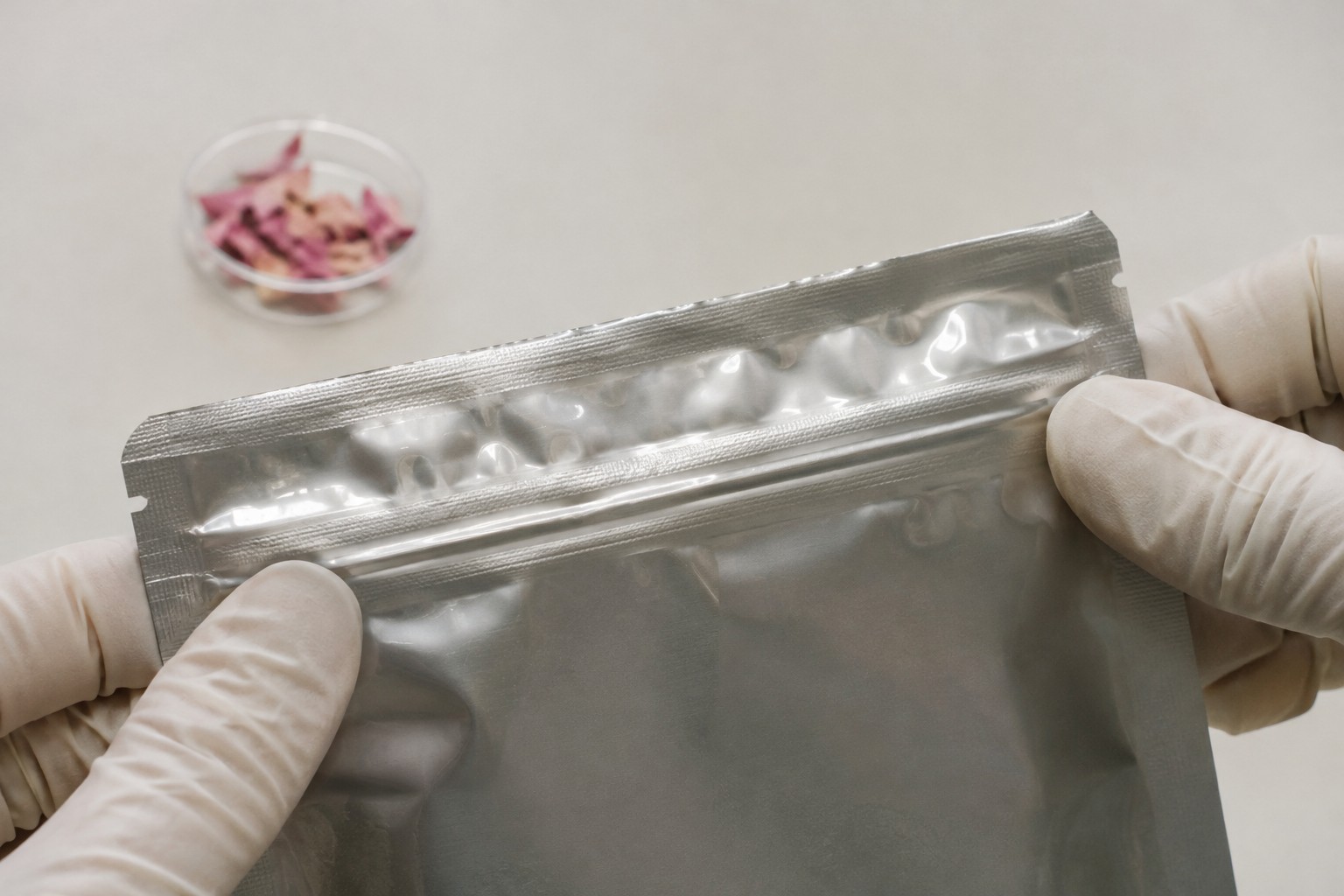
The pink is what you are selling, and it is the thing a clear bag slowly removes. This is the same argument that applies to matcha, and it points the same way: an opaque barrier bag, or at most a small window.
We fill and heat seal in ambient air, with no nitrogen flushing and no vacuum on any format, so the bag is the only protection we add. For a pale pink product that will sit under shop lighting, that is worth spending the extra fifteen cents on.
| Code | Option | Size | Per piece |
|---|---|---|---|
| PKG-012 | Aluminium stand up pouch with zipper | 130 by 130 mm | USD 0.30 |
| PKG-029 | Biomass metallised kraft three side seal | 110 by 125 mm | USD 0.20 |
| PKG-010 | Biomass metallised kraft stand pouch with zipper | 180 by 240 mm | USD 0.60 |
A worked first order
Five hundred retail bags of 5 g dried petals, our aluminium stand up pouch, one front label, two and a half kilograms of dried blossom from your producer.
| Line | Unit | 500 bags |
|---|---|---|
| Fill & seal | USD 0.65 per bag | USD 325.00 |
| Aluminium pouch with zipper, 130 by 130 mm | USD 0.30 per piece | USD 150.00 |
| Label application, one position | USD 0.15 per position | USD 75.00 |
| Set up fee, first order only | USD 130 once | USD 130.00 |
| Dispatch handling | USD 2.55 per shipment | USD 2.55 |
| Total, first order | USD 682.55 | |
| Per bag, first order | USD 1.37 | |
| Per bag, repeat orders | USD 1.11 |
The blossom and the freight sit on top, and both are yours. What the table shows is that the packing side of a sakura launch is under seven hundred dollars, which is almost never the number that decides a sakura project. The material and the calendar are.
How to measure the volume before you choose a bag
Dried petals are bulky enough that a weight tells us very little. Weigh out the fill weight you are planning, tip it loosely into a kitchen measuring jug without pressing it down, and send us the millilitres with the grams. That one number settles the bag choice, and it takes two minutes.
Pairing sakura with a second product
Our minimum is counted across the whole order rather than per product, which matters more for sakura than for most things, because a sakura line on its own is seasonal and small.
Running it alongside a year round product means the sakura rides on an order that was going to happen anyway: one set up fee, one shipment, one set of dates. For a brand with a matcha or a hojicha line already, adding 200 bags of sakura powder to a spring order is a very cheap way to have a seasonal product at all.
The alternative, running 500 bags of sakura on its own once a year, works too. It just carries the whole order on one seasonal product, and the dates are set by a harvest you do not control.
What to tell us when you ask
- Which form: salt pickled, dried petals or powder. This is the first question.
- Which year the material is from, and when it will physically exist.
- The fill weight per bag and the total bag count.
- Whether you want a stock bag or are supplying printed bags yourself.
- The date you need finished stock in your own warehouse.
Rates, minimums and conditions are on the contract packing page.
Questions we get asked
Can you fill salt pickled sakura?
No. It is wet and normally chilled, and we are a dry goods line working at ambient temperature only. This is not a quantity question or a scheduling question, it is simply outside what the line does.
Can you dry the blossom for me?
No. Drying belongs to your producer. The material reaches us finished.
When should I start a sakura project?
About a year before you want to sell it. The material exists in spring, interest peaks in spring, and the two are a season apart. Agree the quantity with your producer before the blossom rather than after it.
How much material does a first order need?
Very little by weight. Five hundred bags of 5 g dried petals is two and a half kilograms net. The constraint is volume, not weight, so the bag has to be chosen from a sample.
Can you blend sakura with sugar or salt?
Only as a measured mix, at USD 1.10 a bag instead of USD 0.65, with both components arriving finished and the grams of each specified. We do not develop the blend.
Related reading
- Yuzu, where the harvest sets your window
- The three weeks when nothing ships in Japan
- A packer is not a manufacturer
- Stock bags and what each one costs per piece
Tell us which form the sakura arrives in. That answers most of the question before we talk about price. WhatsApp reaches us fastest, and we answer in English. If you would rather not use it, the enquiry form does the same job.
Message us on WhatsApp Use the enquiry form Agriture Inc., Kyoto, Japan- Rice Flour Is Dense, Which Makes It the Cheap One to Bag
- How to Find a Contract Packer in Japan From Outside Japan
この記事を書いた人
関連記事
-
 Organic, Halal, Vegan: the Claims We Cannot Certify
-
What Goes on the Label, and Who Supplies It
-
Boxed Sets and Multi Packs: the Count That Decides Everything
-
Private Label Matcha: Who Sells You the Tea, and Who Bags It
-
Hojicha Is the Easy One to Bag, and the Roast Is Why
-
Tea Filter Bags in Small Quantities, and the Arithmetic Nobody Expects
-
Pack It in Japan, or Ship It Home in Bulk and Pack It There
-
Dried Shiitake: the One Where the Customer Wants to See It