A Packer Is Not a Manufacturer: What We Will Not Do

An enquiry that has to be turned down is usually not unreasonable. It is addressed to the wrong kind of company. Someone wants matcha blended to a recipe, or vegetables dried and then milled, or a laboratory report, and they have written to a packing line because the words contract and Japan appeared in the same search result.
So here is the boundary, stated plainly, with the full list of what falls outside it. Reading this first will save you a week, whichever side of the line your project sits on.
目次
What the two kinds of company actually do
| Contract manufacturer | Packer, which is us | |
|---|---|---|
| Starts with | Unfinished material | A finished product |
| Transforms the product | Yes, that is the job | No, never |
| Decides the recipe | Often, with you | No |
| Weighs into retail bags | Sometimes, as a final step | Yes, that is the job |
| Typical minimum | Set by a production batch | Set by a bag count, ours is 500 |
| What you send | Ingredients, plus a brief | The finished product, ready to bag |
A contract manufacturer changes what your product is. We change what it is in. That distinction decides almost every question people ask us, including the ones about price, because a packing run is cheap and fast precisely because nothing is being made.
What we do
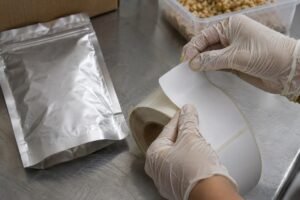
The whole scope, in one list. Your finished material arrives at our line in Kyoto and we:
- Weigh it into bags, to your gram weight, with no minimum on the fill weight.
- Heat seal them.
- Apply your labels, charged per position, so a front and a back label are two positions.
- Pack the finished bags into shipping cartons.
- Hand the cartons to your forwarder inside Japan.
That is it, and it is deliberately that short. Filling is USD 0.65 a bag at any gram weight, or USD 1.10 when more than one finished component is weighed into the same bag. The minimum is 500 bags per order counted across every size and recipe in it, and the 500 bag article explains how to combine formats to reach that.
What we will not do
None of these are negotiable at any quantity, because the line does not have the equipment or the role for them.
| Step | Status |
|---|---|
| Drying fresh material | Not offered |
| Milling / powdering | Not offered |
| Roasting | Not offered |
| Recipe development / blend design | Not offered |
| Laboratory analysis, including microbiological testing | Not offered |
| A paid sample development service | Not offered |
| Nitrogen flushing / modified atmosphere | Not offered |
| Vacuum sealing | Not offered |
| Stick packs / sachet sticks | Equipment cannot run this format |
| Refrigerated / frozen handling | Not offered, ambient dry goods only |
| Acting as importer of record | Not offered, the entry is yours |
A few of those are worth a sentence each, because they are the ones people hope are flexible.
Blending, and the one thing that looks like blending
We do not design a blend. We will not tell you what ratio of two teas tastes better, and we will not develop a formulation from a description of what you want the product to be. That is product development and it belongs with your producer or a contract manufacturer.
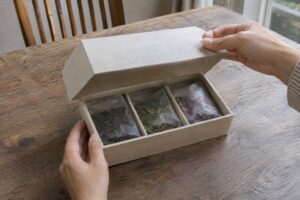
What we will do is weigh several finished components into the same bag. You tell us the grams of each, we put exactly that in, and it is charged at USD 1.10 a bag rather than USD 0.65 because it is two or more weighing operations. If you arrive with a ratio already decided, that is a filling job. If you arrive wanting help deciding the ratio, it is not.
No gas flushing, on any format
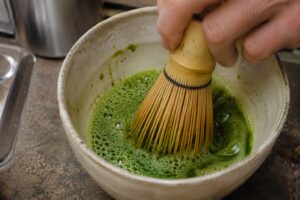
Bags are filled and heat sealed in ambient air. This rules us out for a shelf life specification that depends on a nitrogen headspace, and it is the most common honest reason a matcha project should go elsewhere. An aluminium barrier bag narrows the gap and does not close it. The stock bag list covers what the materials can and cannot do for you.
No testing, and what that means for your paperwork
We do not run laboratory analysis, so we cannot provide microbiological results, nutritional panels or shelf life study data for your product. If your buyer or your own regulator wants those, they have to come from your producer or an accredited laboratory. Plan for that early, because it is usually the longest lead item in a launch and it has nothing to do with the packing schedule.
No trial service
There is no paid sample development step to buy before a real order. The thing to ask instead is whether your material will run, which is a conversation, not a service. If there is a genuine question about how a powder flows, we will say we need the material in hand to answer it instead of guessing.
How to tell which one you need
Four questions settle it almost every time.
- Is the product finished exactly as your customer will consume it? If yes, you want a packer.
- Does anything still have to be dried, milled, roasted, mixed to a recipe or cooked? If yes, you want a manufacturer first, and a packer afterwards.
- Do you know the gram weight and the bag count? If yes, a packer can price it today.
- Are you asking what the product should be? Then the question is a product development question, and no packing quote will answer it.
It is common for a project to need both, in order. Your producer makes and mills the powder, we put it into retail bags. Those are two suppliers and two conversations, and trying to get one company to do both is what makes a simple project take six months.
Where each request actually belongs
Most of what gets asked of us belongs to somebody, just not to us. This is the routing, so you can send the question to the right place first time.
| What you are asking for | Who does it |
|---|---|
| Dry the leaf, the peel, the root | Your producer, before it ships to us |
| Mill it to a powder | Your producer |
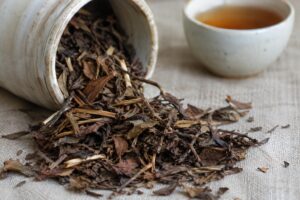
| Roast it, change the roast | Your producer |
| Develop a recipe | A contract manufacturer |
| Blend two ingredients to a formula | A contract manufacturer |
| Weigh two finished powders into one bag | Us, as a measured mix at USD 1.10 a bag |
| Microbiological testing, nutrition panels | An accredited laboratory |
| Shelf life study | An accredited laboratory |
| Decide what the label may claim | Your customs broker, your regulator |
| Weigh, seal, label into retail bags | Us |
| A single serve stick pack | Nobody here. Our equipment cannot run it |
The pattern is that anything which changes the material belongs upstream, anything which measures the material belongs to a laboratory, anything which decides what you may say belongs to a regulator, and what is left is ours. It is a short list, which is why we can quote it in a day.
Worth knowing which way the lead times run, too. The laboratory work and the regulatory answers are usually the longest items in a launch, often months rather than weeks, while our part is three to four weeks once your material is in Kyoto. Brands who start with the packing quote because it is the easy one to get tend to find the packing was never the constraint.
Why the narrow scope is good for you
A packing line that does not make anything has no formulation to protect, no development time to bill and no batch size dictated by a cooking vessel. That is why the minimum is a bag count of 500, why the lead time is three to four weeks, and why there is nothing to buy up front except a one time USD 130 set up fee.
It also means we have no opinion about your product, which some brands find unhelpful and others find restful. You own the recipe, the producer relationship and the decisions. We own the bag.
What to send us so we can say yes quickly
- What the material is, and confirmation that it is already finished.
- The bag size in grams and the total bag count.
- Whether you want our stock bags or will supply your own.
- How many label positions.
- The date you need finished stock in your warehouse.
With those five lines we can price it, or tell you honestly that the project needs a manufacturer rather than us. Both answers are faster than a round of discovery, and the second one is the more useful of the two if it is true.
The scope, the minimums and the full rate card are on the contract packing page.
Questions we get asked
Will you develop a product for me?
No. We do not formulate, we do not develop blends and we do not run recipe work. What we do is weigh a finished material into retail bags and seal them.
Can you dry, mill or roast my material?
No. Anything that changes the material belongs upstream, with your producer, before it ships to us. The product reaches our line finished.
Can you run laboratory tests or give me a shelf life?
No. We do not run analysis of any kind, so no microbiological results, no nutritional panels and no shelf life studies. Those come from an accredited laboratory, and they are usually the longest lead item in a launch.
Can you make a stick pack?
No. A single serve stick is the one format our equipment genuinely cannot run. The nearest alternatives in our range are a small flat pouch or a three side seal sachet.
Can you mix two of my ingredients together?
Yes, if you tell us the grams of each. That is a measured mix at USD 1.10 a bag instead of USD 0.65, because it is two weighing operations. It is a filling job, not blend development.
Related reading
- The claims we cannot certify
- What a 500 bag minimum really means
- Stock bags and what each one costs per piece
- Packed in Japan or product of Japan
- How Japanese suppliers quote and get paid
Five lines and we can tell you yes or no. An honest no is faster than a round of discovery. WhatsApp reaches us fastest, and we answer in English. If you would rather not use it, the enquiry form does the same job.
Message us on WhatsApp Use the enquiry form Agriture Inc., Kyoto, Japan- Sending Your Material to a Japanese Packer
- Yuzu Powder: the Harvest Sets Your Window, Not Your Launch Date
この記事を書いた人
関連記事
-
 Organic, Halal, Vegan: the Claims We Cannot Certify
-
What Goes on the Label, and Who Supplies It
-
Boxed Sets and Multi Packs: the Count That Decides Everything
-
Private Label Matcha: Who Sells You the Tea, and Who Bags It
-
Hojicha Is the Easy One to Bag, and the Roast Is Why
-
Tea Filter Bags in Small Quantities, and the Arithmetic Nobody Expects
-
Pack It in Japan, or Ship It Home in Bulk and Pack It There
-
Dried Shiitake: the One Where the Customer Wants to See It