Getting Matcha Packed in Japan: the Numbers That Decide It

Most matcha brands outside Japan hit the same wall. Your producer in Uji or Nishio will happily sell you tea in 1 kg foil bags. Your customer wants 30 g on a shelf. Somebody has to weigh it out and seal it, and doing that yourself in Europe or the US means either a co-packer who has never handled matcha or a kitchen table and a heat sealer.
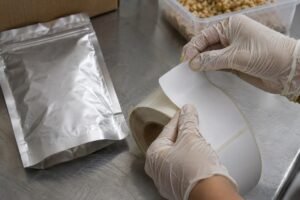
The other option is to have it bagged before it leaves Japan. That is what our line in Kyoto does: we take finished tea, weigh it into bags, seal them, put your labels on and hand the cartons to your forwarder.
One thing to be clear about before you read any further, because it is the commonest misunderstanding in a first enquiry: we do not supply the tea. The matcha is yours. You buy it from your own producer, it arrives at our line finished, and we weigh it. If what you are looking for is a supplier who sells you the tea and bags it under your brand in one contract, that is a different kind of company. Here are the numbers that decide whether this one is worth it, and the two conditions that mean you should not bother asking.
目次
The arithmetic that decides everything
Our minimum is 500 bags per order, and the price per bag does not change with the gram weight. That single fact drives every other decision, because it means your bag size, not your budget, determines how much tea you need before we can run anything.
| Bag size | Tea needed for 500 bags | What it suits |
|---|---|---|
| 10 g | 5 kg | Sample & trial sizes |
| 20 g | 10 kg | Single origin tasting packs |
| 30 g | 15 kg | The common retail tin refill size |
| 40 g | 20 kg | Standard ceremonial retail bag |
| 100 g | 50 kg | Cafe & wholesale size |
If you arrive with 10 kg and a 30 g format in mind, you are at roughly 333 bags and below the minimum. You have two ways out, and neither involves buying more tea: drop to a 20 g bag to reach 500, or split the 10 kg across two sizes and count the bags together. The 500 is a total across the order, not per product, which is the detail that rescues most projects that look short. There is more on how to combine formats in our note on the 500 bag minimum.
What 500 bags of matcha actually costs
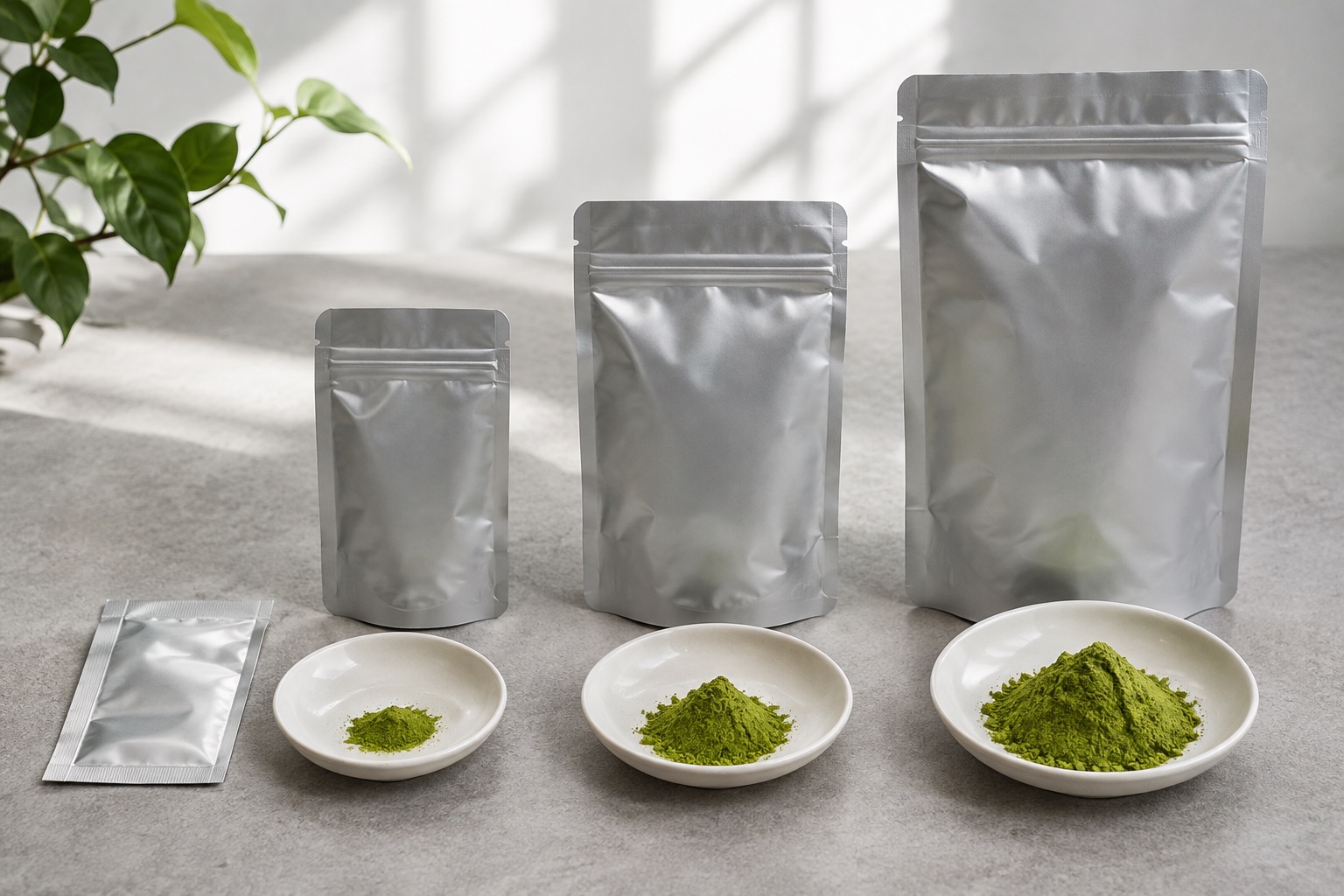
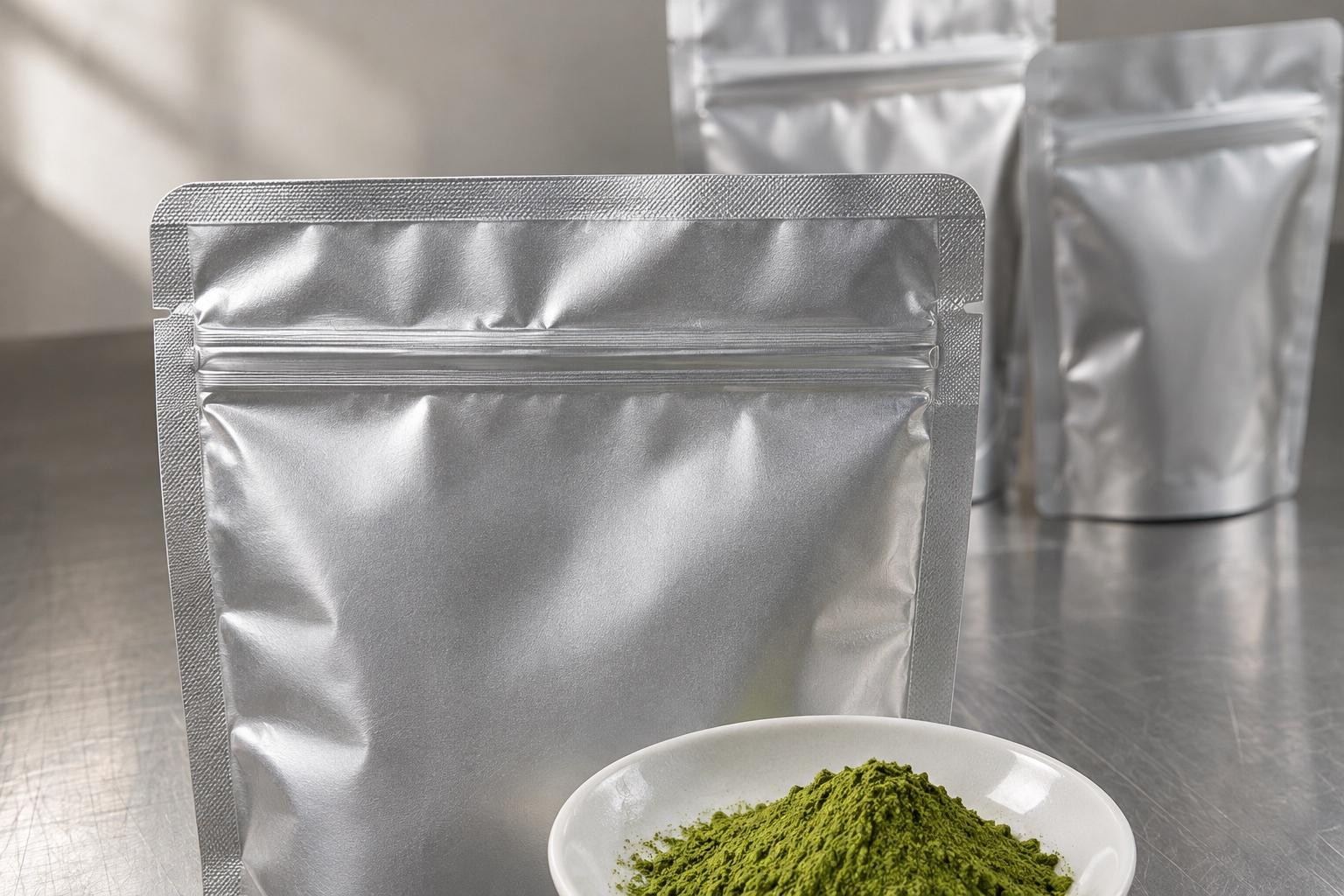
A worked example, using our stock aluminium stand up pouch and one label position. This is the packing cost only. The tea itself and the freight are yours.
| Line | Unit | 500 bags |
|---|---|---|
| Fill & seal | USD 0.65 per bag | USD 325 |
| Aluminium pouch with zipper, 130 by 130 mm | USD 0.30 per piece | USD 150 |
| Label application, one position | USD 0.15 per position | USD 75 |
| Dispatch handling | USD 2.55 per shipment | USD 2.55 |
| Set up fee, first order only | USD 130 once | USD 130 |
| Total, first order | USD 682.55 | |
| Per bag, first order | USD 1.37 | |
| Per bag, repeat orders | USD 1.11 |
The set up fee is charged once, on your first order with us, so a second run of the same job drops by USD 130. Nothing else about the price changes with volume: the per bag rate is flat whether you order 500 or 50,000.
The same job at three sizes
Because the fill rate is flat per bag, the packing cost as a share of your product depends entirely on how much tea goes into each one. Three first orders, each 500 bags, each with one label and the same stock pouch:
| 20 g | 30 g | 40 g | |
|---|---|---|---|
| Tea required | 10 kg | 15 kg | 20 kg |
| Fill, 500 bags | USD 325 | USD 325 | USD 325 |
| Pouches, 500 pieces | USD 150 | USD 150 | USD 150 |
| Labels, one position | USD 75 | USD 75 | USD 75 |
| Set up plus dispatch | USD 132.55 | USD 132.55 | USD 132.55 |
| Packing per bag | USD 1.37 | USD 1.37 | USD 1.37 |
| Packing per 100 g of tea | USD 6.83 | USD 4.55 | USD 3.41 |
The bottom row is the one to look at before you settle a format. Moving from 20 g to 40 g halves what packing adds to each gram the customer buys, and it does not change your packing bill by a single cent. If you are undecided, the larger bag is almost always the better unit economics. The reason to pick the smaller one should be the shelf or the price point, not this table.
What to send us, and in what form
Finished tea, ambient, in sealed bulk bags inside cartons. Your producer can ship to our line directly, which saves a leg.
The one point worth repeating for tea specifically is the overage. Filling to a target weight leaves a small amount in the machine and in the last part filled bag, and matcha is fine enough that this is not a rounding error. Fifteen kilograms of tea does not reliably become 500 bags of exactly 30 g, so send a margin. Tell us the weight you plan to ship with the bag count you want, and we will say whether it is comfortable before you book the freight.
Everything else about that leg is the same for tea as for any other material: what has to be marked on each carton, why the dispatch notice matters, and who is the importer of record. It is all in sending your material to a Japanese packer, which is worth reading before you book anything.
Matcha specifics worth knowing before you commit
We seal in ambient air
We do not run nitrogen flushing, modified atmosphere or vacuum sealing on any format. For a tea where colour is the product, that matters, and it is the honest reason some matcha projects should not come to us. What we can do is put it in an aluminium barrier pouch with a clean seal, which is the same kind of bag a lot of retail matcha is sold in. If your shelf life calculation depends on a nitrogen headspace, we are the wrong line and no bag choice will fix it.
If you are staying with us, the sensible response is to stop treating the bag as the only defence. Order three or four times a year instead of once, pick an aluminium or metallised barrier over a clear window, and keep the gram weight small enough that an opened bag gets used quickly. Our stock bag list gives the per piece prices for each option.
Fine powder behaves differently from leaf
Matcha is a very fine powder and it moves through a filler differently from sencha or dried vegetables. Tell us up front if your tea is unusually fine or prone to clumping. We only need the material in hand when there is a real question about how it flows, and we will say so before you discover it on the day of the run.
We do not touch the tea itself
No blending to a recipe, no milling, no roasting, no laboratory analysis. Your producer makes the tea, you own that relationship, and it arrives at our line finished and ready to go into a bag. If you want someone to develop a blend for you, we are not that company, and the full list of what we will not do is worth two minutes before you send a brief.
One nuance. If your product is matcha plus a second finished ingredient, say a sweetener or a dried fruit powder you have already sourced, we can weigh both into the same bag. That is charged at USD 1.10 per bag rather than USD 0.65, because two measured portions take two operations. It is a filling job, not recipe development: you tell us the grams of each, and that is what goes in.
Stick packs are the one format we cannot run
Single serve matcha in a long thin stick is a common ask and the one thing our equipment genuinely cannot do. Sachet sticks are out. For any other shape, ask before you design around it, and do not assume the answer either way.
Timing, and who handles customs
Three to four weeks from the day the order is confirmed and your tea has reached Kyoto. Both conditions matter: filling runs on a date we schedule for you, so that date rather than the calendar sets your plan, and the clock does not start on a promise of material. Build your plan backwards from the date you need stock in your own warehouse, then add the sea or air leg out of Japan on top.
Then check that window against the Japanese shutdown weeks before you commit to a launch date. New Year, the early May holidays and mid August take whole weeks out of the calendar, and a four week lead time that lands across one of them is really five or six. The Japanese factory calendar has the dates and the way to plan around them.
Customs is yours. We are a packer, not an importer of record, so the tea clears into Japan in your name, or in the name of an agent you have appointed and filed with Japanese customs. Export freight out of Japan is booked by your forwarder. We hand over finished cartons in Japan and that is where our part ends.
If your company has no address in Japan, there is a step before any of that: Japan Customs requires a person living abroad to designate a Customs Procedure Agent in Japan in advance, and importing food for sale also needs a notification to the quarantine station under the Food Sanitation Act. Both are arranged well before the tea ships. Sending your material to a Japanese packer sets out what each one involves.
Payment is the standard Japanese arrangement: we close at the end of the month and the invoice falls due at the end of the following month. For a first order from overseas we confirm the terms with the quotation, so ask us and do not assume when you are planning cash flow. How Japanese suppliers quote and get paid explains what that means in practice.
Is it worth it?
It is worth it when your producer sells in bulk and your market sells in grams, and when you would rather not run a packing operation yourself for a product that ships from Japan in any case. At 500 bags of 30 g you are adding about USD 1.37 a bag on the first order and USD 1.11 after that, with no tooling to buy and nothing to learn about heat sealing.
Below 500 bags we cannot take the order at all, and a shelf life specification that needs a controlled atmosphere rules us out whatever the quantity. Those are the two that stop a matcha project outright. The rest of what we do not do is in what a packer will not do, and everything after that is arithmetic you can run from the tables above.
The full rate card, minimums and conditions are published on our contract packing page.
Questions we get asked
Do you sell the matcha as well?
No. You buy the tea from your own producer and it arrives at our line finished. We weigh it, seal it and label it. Who sells the tea and who bags it is a common point of confusion, and it has its own article.
What is the smallest order you will take?
Five hundred filled bags, counted across the whole order. There is no minimum on the gram weight, so a 5 g sachet is as welcome as a 500 g pouch.
Can you nitrogen flush or vacuum seal matcha?
No. We fill and heat seal in ambient air on every format, with no gas flushing and no vacuum on any product. For a colour sensitive powder that is the reason to choose an opaque barrier bag over a clear one.
How much tea should I actually ship for 500 bags of 30 g?
More than fifteen kilograms. Filling to a target weight leaves a little in the machine and in the last part filled bag, and matcha is fine enough that this is not a rounding error. Tell us the weight you plan to ship with the bag count you want and we will say whether it is comfortable.
Can you make a matcha latte blend for me?
No. We do not develop blends. We can weigh two finished components into one bag to a ratio you give us, at USD 1.10 a bag instead of USD 0.65, but working out what the ratio should be is a contract manufacturer’s job.
Related reading
- Who sells you the tea, and who bags it
- What a 500 bag minimum really means
- Stock bags and what each one costs per piece
- Sending your material to a Japanese packer
- The three weeks when nothing ships in Japan
Send us the bag size and the quantity. That is enough to price it. WhatsApp reaches us fastest, and we answer in English. If you would rather not use it, the enquiry form does the same job.
Message us on WhatsApp Use the enquiry form Agriture Inc., Kyoto, Japan- What a 500 Bag Minimum Really Means at a Japanese Packer
- Our Stock Bags, and What Each One Costs Per Piece
この記事を書いた人
関連記事
-
 Organic, Halal, Vegan: the Claims We Cannot Certify
-
What Goes on the Label, and Who Supplies It
-
Boxed Sets and Multi Packs: the Count That Decides Everything
-
Private Label Matcha: Who Sells You the Tea, and Who Bags It
-
Hojicha Is the Easy One to Bag, and the Roast Is Why
-
Tea Filter Bags in Small Quantities, and the Arithmetic Nobody Expects
-
Pack It in Japan, or Ship It Home in Bulk and Pack It There
-
Dried Shiitake: the One Where the Customer Wants to See It