Private Label Matcha: Who Sells You the Tea, and Who Bags It

Search for a private label matcha supplier in Japan and most of what comes back reads as though one company does the whole job: grows the tea, mills it, prints your bag, ships you a finished product. A few companies are built that way. Most of the Japanese supply chain is not, and that difference is where first projects stall.
Here is the plain version of how the work divides up, because knowing it changes who you email first.
目次
Two companies, not one
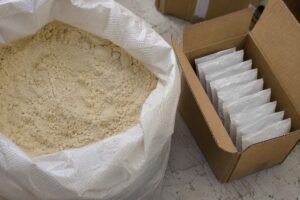
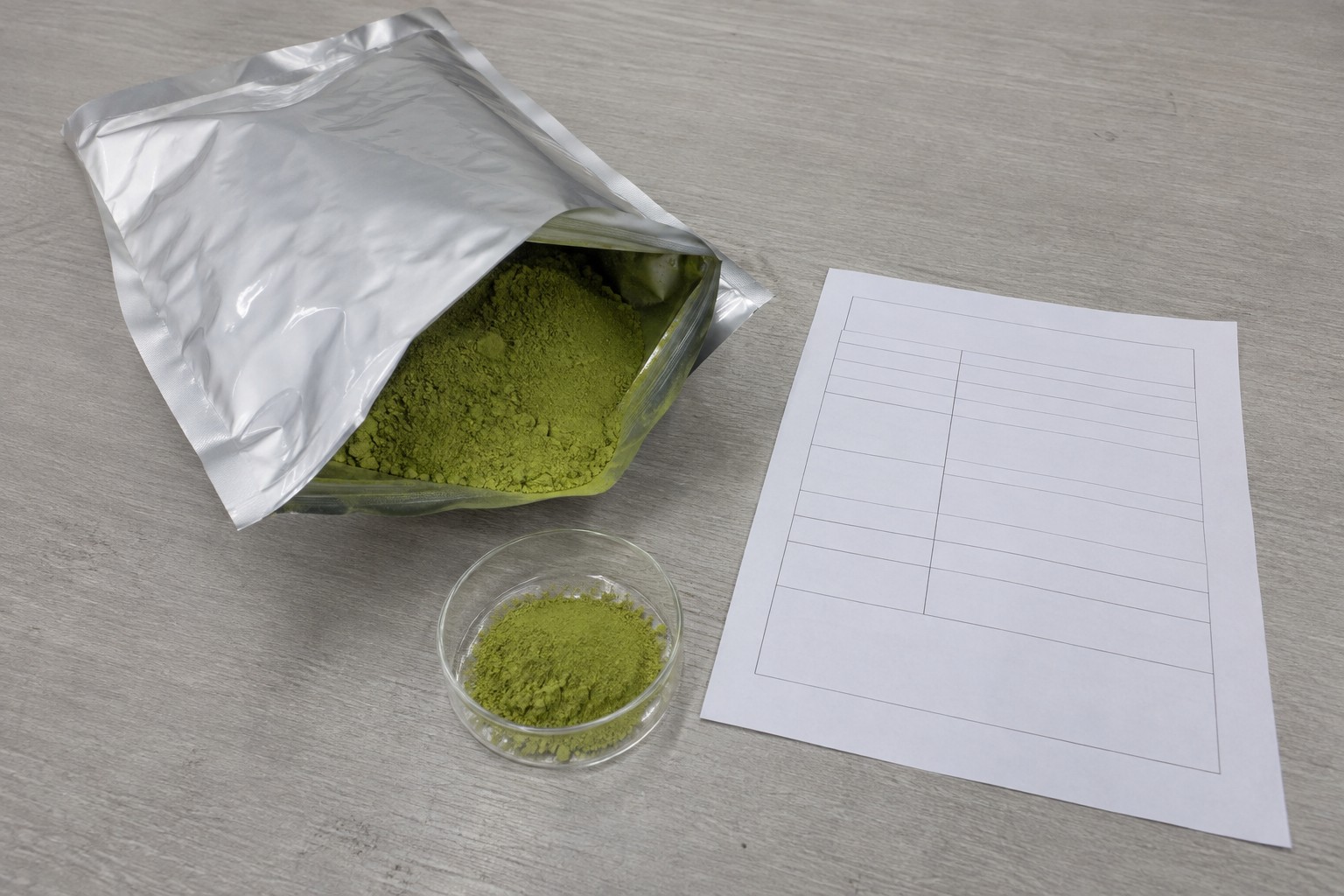
A private label matcha product has two suppliers behind it. One grows the leaf and mills it into matcha. The other weighs that matcha into retail bags and seals them. We are the second one. We do not sell tea.
That is worth saying twice, because it is the single most common misunderstanding in a first enquiry. The matcha is yours. You buy it from a producer, you own that relationship, you agree the grade with them, and the tea reaches our line in Kyoto already finished and ready to weigh.
| Your tea producer | Us, the packing line | |
|---|---|---|
| Owns | The tea, the grade, the harvest | Nothing. Your material stays yours |
| Decides | Cultivar, region, grind, price per kilo | Nothing about the product itself |
| Minimum | Set by their own production | 500 filled bags per order |
| Lead time | Theirs to quote | Three to four weeks once material is here |
| Delivers | Tea in bulk, usually 1 kg foil bags | Retail bags, filled, sealed, labelled |
Why the two jobs are rarely sold together
It is not secrecy or protectionism. The capital sits in different places. A tea producer has money in fields, in shade structures, in stone mills. A packing line has money in fillers, sealers, label applicators. Neither investment makes the other one cheap to add, so most companies do one of them properly.
There is a commercial reason too. A producer who also bags for you has you tied to their tea. Keeping the two separate means you can change grade, change producer, or run two origins through the same retail format, without renegotiating the packing. Most brands discover they want that in year two.
What to settle with a tea producer
This is the conversation that decides your product. Have it first, because everything we quote depends on what comes out of it.
- The grade, in their words, with a sample in your hand. Ceremonial, culinary and latte grade are marketing terms that shift by company.
- Which harvest, and which year. It changes colour, aroma, price.
- The particle size. A fine matcha behaves differently on a filling line from a coarse one, so we need to know it as well.
- Price per kilo at the quantity you actually need, not at a tonne.
- Whether they will sell you fifteen kilograms at all. Some will not.
- Who pays for the leg to Kyoto, who books it, who is named on the paperwork.
- What documentation they can supply for your market. Test reports and specifications come from them, never from a packing line.
Ask for a sample of the lot you are actually buying, not of the grade in general. Matcha moves year to year, and a producer showing you last season at its best is not being dishonest, just normal. The sample in your hand should match the kilograms arriving in Kyoto, because by the time it reaches us it is going into bags whatever it looks like.
What to settle with us
Much shorter, because our side has fewer variables. Four lines are enough to get a priced answer back.
- What the material is, and confirmation that it is finished.
- The fill weight you want in each bag.
- The total bag count across the order.
- The date you need finished stock in your own warehouse.
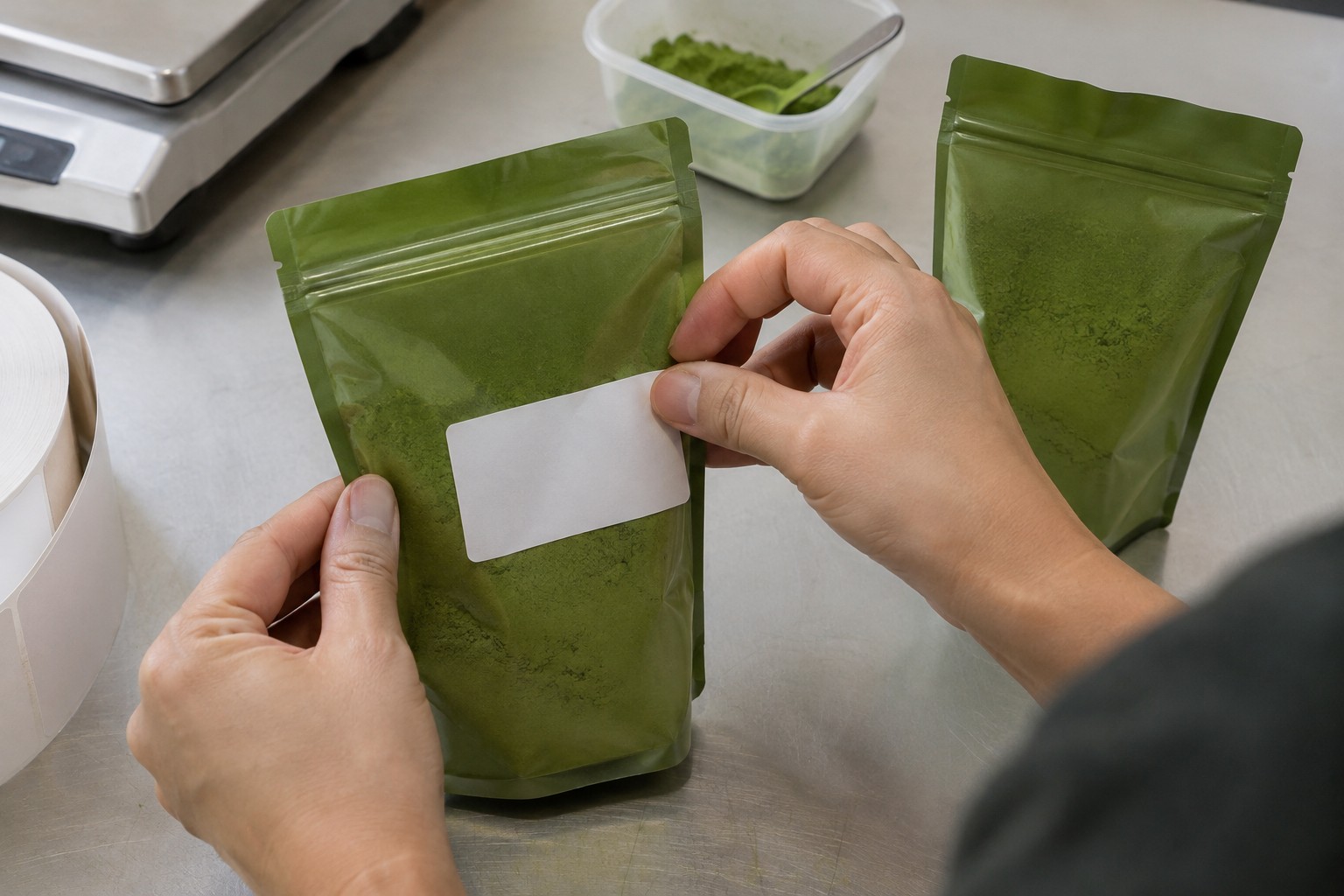
Add the bag if you have chosen one. We hold 25 stock bag types and the matcha default is an aluminium stand up pouch with a zipper at 130 by 130 mm, USD 0.30 a piece. The full stock list has the rest, with the sizes and the per piece prices.
What the packing half costs
Filling is USD 0.65 a bag and it does not move with quantity. A first order carries a one time set up fee of USD 130, and labels are USD 0.15 per position. For a 500 bag first order in a stock pouch with one label, the packing side lands around seven hundred dollars in total. The matcha article has the worked table at three fill weights, which is the one to read before you pick a retail size.
Compare that with the tea itself. Five hundred bags at 30 g is fifteen kilograms of matcha, and at almost any grade worth selling, that is the larger number by a wide margin. The packing is rarely what decides whether a project works.
The order to do it in
- Agree the tea first. The grade sets your shelf price, which sets everything else.
- Decide the retail format second, because the fill weight sets how much tea you have to buy.
- Confirm the bag plus the packing dates with us third.
- If the tea is coming from outside Japan, arrange the import before you ship. Sending material to a Japanese packer has the two approvals a foreign company needs first.
- Book export freight last, once the finish date is real.
Brands who do it in the reverse order, starting from a launch date and working towards a supplier, usually find the tea they wanted does not exist in the quantity they need at the moment they need it.
Who answers which question
| The question | Ask |
|---|---|
| What grade is this, what does it taste like | Your producer |
| What did it cost per kilo | Your producer |
| Which harvest, which year | Your producer |
| Can I call it ceremonial grade on the bag | Your broker / your regulator |
| Will this powder run through a filler | Us, with a sample in hand |
| What does a 30 g retail bag cost to fill | Us |
| Which stock bag suits 30 g of matcha | Us |
| Is this organic certified | The certifying body, through your producer |
| Who is the importer of record in Japan | You. It is never us |
Nine questions, three different places, and the pattern holds for every ingredient we handle. Material questions go upstream, format questions come to us, claims go to whoever regulates the market you are selling in.
The two minimums have to be reconciled
This is the practical trap in the two supplier model, and it is arithmetic rather than anything else. Your producer sells by the kilogram. We count bags. The two numbers have to meet in the middle, and they do not always want to.
Work it from the retail format. Five hundred bags of 30 g is fifteen kilograms of matcha. Five hundred bags of 20 g is ten. Five hundred bags of 40 g is twenty. So your smallest possible first order, in tea, is set by the shelf size you picked long before you spoke to anybody.
| Retail size | Our minimum in bags | Matcha you have to buy |
|---|---|---|
| 20 g | 500 | 10 kg net, plus a margin |
| 30 g | 500 | 15 kg net, plus a margin |
| 40 g | 500 | 20 kg net, plus a margin |
| 100 g, food service | 500 | 50 kg net, plus a margin |
Now take that number to the producer. If their smallest sensible sale is thirty kilograms and your format needs ten, you have a mismatch to solve: buy more tea than you need, change the retail size, or find a producer who will sell smaller. All three are normal answers. What does not work is discovering it after you have committed to artwork.
Send more tea than the multiplication says
The weights above are net, meaning what ends up inside the bags. Filling to a target weight leaves a little in the machine and in the last part filled bag, and matcha is fine enough that this is not a rounding error. Fifteen kilograms shipped does not reliably become 500 bags of exactly 30 g.
Tell us the weight you plan to buy with the bag count you want, and we will say whether it is comfortable before you place the order with your producer. This is a question worth asking in the opposite order from the one most people use.
If you do want one contract for both
Then you want a trading company or a contract manufacturer, and you should say so plainly in your first email to anybody. There are firms that will buy the tea on your behalf, bag it, and invoice you once. They cost more, because somebody is carrying the material risk for you, and they usually come with their own view of which tea you should be selling.
We are the other model. Narrow scope, published rates, and you keep the producer relationship. What a packer will not do sets out the boundary in full, including the things we are asked for most often and have to decline.
Our rates, minimums and conditions are on the contract packing page.
Questions we get asked
Do you supply the tea?
No. You buy the matcha from your own producer and own that relationship. We weigh it into retail bags and seal them.
Why will nobody quote me for the tea and the bagging together?
Because the capital sits in different places. A producer has money in fields and mills, a packing line has money in fillers and sealers. If you want one contract for both, you want a trading company or a contract manufacturer.
How much matcha do I need for a first order?
Work it from the retail size. Five hundred bags of 30 g is fifteen kilograms net, plus a margin for the overage. Twenty gram bags need ten kilograms, forty gram bags need twenty.
What if my producer will not sell that little?
That is the mismatch to solve first, and all three answers are normal: buy more than you need, change the retail size, or find a producer who sells smaller. Discovering it after the artwork is finished is the version that costs money.
What should I ask a producer for?
A sample of the lot you are actually buying, not of the grade in general, plus the harvest and year, the particle size, the price at your real quantity, and what documentation they can supply for your market.
Related reading
- What 500 bags of matcha costs
- What a 500 bag minimum really means
- Pack in Japan, or ship bulk and pack at home
- A packer is not a manufacturer
Tell us the grade, the fill weight and the bag count. That is enough to price the packing half. WhatsApp reaches us fastest, and we answer in English. If you would rather not use it, the enquiry form does the same job.
Message us on WhatsApp Use the enquiry form Agriture Inc., Kyoto, Japan- Packed in Japan or Product of Japan: Two Different Claims
- Hojicha Is the Easy One to Bag, and the Roast Is Why
この記事を書いた人
関連記事
-
 Organic, Halal, Vegan: the Claims We Cannot Certify
-
What Goes on the Label, and Who Supplies It
-
Boxed Sets and Multi Packs: the Count That Decides Everything
-
Hojicha Is the Easy One to Bag, and the Roast Is Why
-
Tea Filter Bags in Small Quantities, and the Arithmetic Nobody Expects
-
Pack It in Japan, or Ship It Home in Bulk and Pack It There
-
Dried Shiitake: the One Where the Customer Wants to See It
-
Sakura: the Form It Arrives In Decides Whether We Can Run It at All