Sampling at a Trade Show: How Many, What Size, How Early

A trade show sample is a different product from a retail bag, and it is worth treating it as one. It has to survive a suitcase, be handed over in two seconds, carry enough information to be found again, and cost little enough that you do not flinch when somebody takes three.
Our fill rate does not change with the gram weight, which makes very small formats more workable here than they are as retail products. The parts that catch people out are the quantity and the lead time.
目次
The formats worth looking at
| Code | Format | Size | Per piece | Suits |
|---|---|---|---|---|
| PKG-018 | Plain sweets pack, semi clear matte | 100 by 120 mm | USD 0.10 | The cheapest giveaway we hold |
| PKG-016 | Plain sweets pack, clear | 100 by 135 mm | USD 0.10 | When the product looks good |
| PKG-029 | Biomass metallised kraft, three side seal | 110 by 125 mm | USD 0.20 | A sample that feels like a product |
| PKG-015 | Clear flat pouch | 100 by 120 mm | USD 0.15 | A small retail size, sold / given |
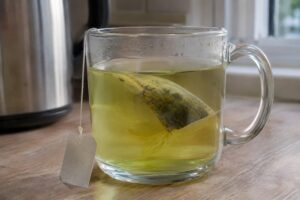
| PKG-014 | Tagged mesh tea filter | 65 by 80 mm | USD 0.25 | Leaf. A tagged bag is a better object than a leaflet |
The tagged tea filter is the one worth a second look if you sell leaf. A single brewing bag with a printed tag gets taken home and used, which is more than most printed material achieves. It has its own article, because the minimum counts filled filters.
What a sample actually costs
Packing only. The product inside is yours, and at sample fill weights it is usually the smaller number.
| Format | Fill | Bag | Label | Per sample |
|---|---|---|---|---|
| 3 g, PKG-018, one label | USD 0.65 | USD 0.10 | USD 0.15 | USD 0.90 |
| 5 g, PKG-029, one label | USD 0.65 | USD 0.20 | USD 0.15 | USD 1.00 |
| 10 g, PKG-015, one label | USD 0.65 | USD 0.15 | USD 0.15 | USD 0.95 |
| 2 g tea filter, no label | USD 0.65 | USD 0.25 | USD 0.90 |
Around a dollar a sample is the honest range, before the product. That is high against a leaflet and low against a branded object somebody keeps, and the comparison that matters is the second one.
It also means the sampling budget is easy to size. Five hundred samples is roughly five hundred dollars of packing plus the product, which for most brands is a smaller number than the stand, the flights or the printed material going on the same trip. Sampling is rarely the line worth cutting.
The reason it does not get cheaper at a sample size is that the USD 0.65 is a filling operation rather than a quantity of material. The same arithmetic applies to single serve products, where it matters rather more.
How many to take
Our minimum is 500 filled bags across the order, which maps onto event sampling unusually well. Five hundred samples is a realistic quantity for one show.
| Event | Samples to plan for | Notes |
|---|---|---|
| A small trade fair, one day | 200 to 300 | Pair it with a retail order to reach 500 |
| A two / three day trade show | 500 | A single order covers it |
| A large international show | 1,000 plus | Two orders worth, / plan a reorder |
| A tasting at one retailer | 100 to 200 | Too small on its own. Add it to a run |
Anything under 500 is not an order on its own, and the way to handle it is to put the samples on the same run as something else. The count is a total across the order, so 300 retail pouches plus 200 sachets is one order, one set up fee, one shipment. The 500 bag minimum has the detail.
What to put on it
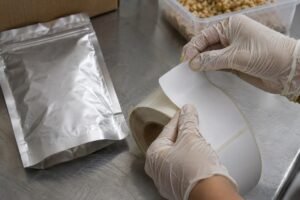
A sample that cannot be traced back to you is a wasted dollar. Labels are USD 0.15 per position, and a back label counts as a second position, so there is room for more than a logo.
- The product name, in the language of the people at the show.
- Your website, legibly, at a size somebody can read without glasses.
- A barcode if the sample doubles as a retail unit. We can apply a label with a barcode printed on it.
- The fill weight, because buyers ask.
- Anything your market requires on a food label, which is your broker’s question rather than ours.
What we apply is whatever you supply. We do not design or print artwork, and the wording is between you and whoever regulates the market you are sampling in.
Getting them to the event
Samples are physically small but not weightless, and the leg from Kyoto to a show is the part people leave until last.
We hand finished cartons over inside Japan to the forwarder you nominate. We do not book international freight. Where our part ends covers that boundary, and for a show it is worth arranging the delivery address before the run rather than after, because an exhibition venue usually has a receiving window measured in days rather than weeks.
Five hundred 3 g sachets is a small consignment. Some brands carry them as accompanied baggage, which is a customs question for the country you are entering rather than anything we can advise on. Ask your forwarder or the show organiser, and ask before you plan around it.
Book earlier than feels necessary
This is the part that goes wrong. Our lead time is three to four weeks from the day the order is confirmed and your material has reached Kyoto, and then the finished cartons still have to get from Japan to the show.
Work backwards: the show date, minus international freight, minus three to four weeks of filling, minus the time for your material to reach us. For an event in early May or late August you are also planning around a Japanese shutdown. The three weeks when nothing ships has the windows, and Golden Week sits directly in front of the European spring show season.
Two months before the event is comfortable. Three weeks before is not a conversation we can usually make work.
Pair it with your first retail order
The strongest reason to think about samples now rather than later is that they cost almost nothing extra when they share an order.
The 500 is a total across everything in one run. Three hundred retail pouches plus two hundred sachets of the same material is one order, one set up fee of USD 130, one dispatch handling charge, one shipment out of Japan. Ordered separately, the samples would carry a set up fee of their own on a first order plus their own freight.
It also means the show and the shelf launch share a schedule, which is usually what you wanted anyway: a buyer who liked the sample can be told the product is already available rather than coming soon.
What to tell us when you ask
- The event date, which is the constraint everything else bends around.
- The fill weight per sample and the total count.
- Whether retail stock is going on the same order.
- Whether you need a barcode or a back label.
- Where the finished samples have to be delivered inside Japan.
Rates, the full stock list, minimums and conditions are on the contract packing page.
Questions we get asked
Can you do fewer than 500 samples?
Not as an order on its own. Put them on the same run as a retail product and the count is a total, so 200 samples alongside 300 pouches clears the minimum.
Can you print our design on the sachet?
Our stock bags are unprinted. We apply labels at USD 0.15 per position, or you supply printed sachets with a flat USD 45 handling charge per order.
Can you put a barcode on it?
Yes, on a label. You generate the barcode and supply it as part of the artwork, and we apply the label like any other.
How far ahead should I order?
Two months before the event. Three to four weeks of that is the filling, and the rest is material arriving plus freight out of Japan.
Can you ship the samples straight to the venue?
We hand finished cartons over inside Japan to the forwarder you nominate. Where our part ends covers that leg, and your forwarder arranges delivery to the show.
Related reading
- Single serve without a stick pack
- Tea filter bags in small quantities
- What a 500 bag minimum really means
- The three weeks when nothing ships in Japan
Tell us the event date and the sample count. The date is the thing that decides whether it is possible. WhatsApp reaches us fastest, and we answer in English. If you would rather not use it, the enquiry form does the same job.
Message us on WhatsApp Use the enquiry form Agriture Inc., Kyoto, Japan- Single Serve Without a Stick Pack: What We Can Run Instead
- Loose Leaf Is Not a Powder, and the Bag Has to Know That
この記事を書いた人
関連記事
-
 Organic, Halal, Vegan: the Claims We Cannot Certify
-
What Goes on the Label, and Who Supplies It
-
Boxed Sets and Multi Packs: the Count That Decides Everything
-
Private Label Matcha: Who Sells You the Tea, and Who Bags It
-
Hojicha Is the Easy One to Bag, and the Roast Is Why
-
Tea Filter Bags in Small Quantities, and the Arithmetic Nobody Expects
-
Pack It in Japan, or Ship It Home in Bulk and Pack It There
-
Dried Shiitake: the One Where the Customer Wants to See It