Loose Leaf Is Not a Powder, and the Bag Has to Know That

Most of our line is powders. Leaf is a different material in almost every way that matters to a filling machine, and brands who have packed a powder before are reliably surprised by it.
Three differences do the work: leaf is bulky, it weighs less precisely, and it is worth looking at. Each one points at a different decision.
目次
Volume, not weight, picks the bag
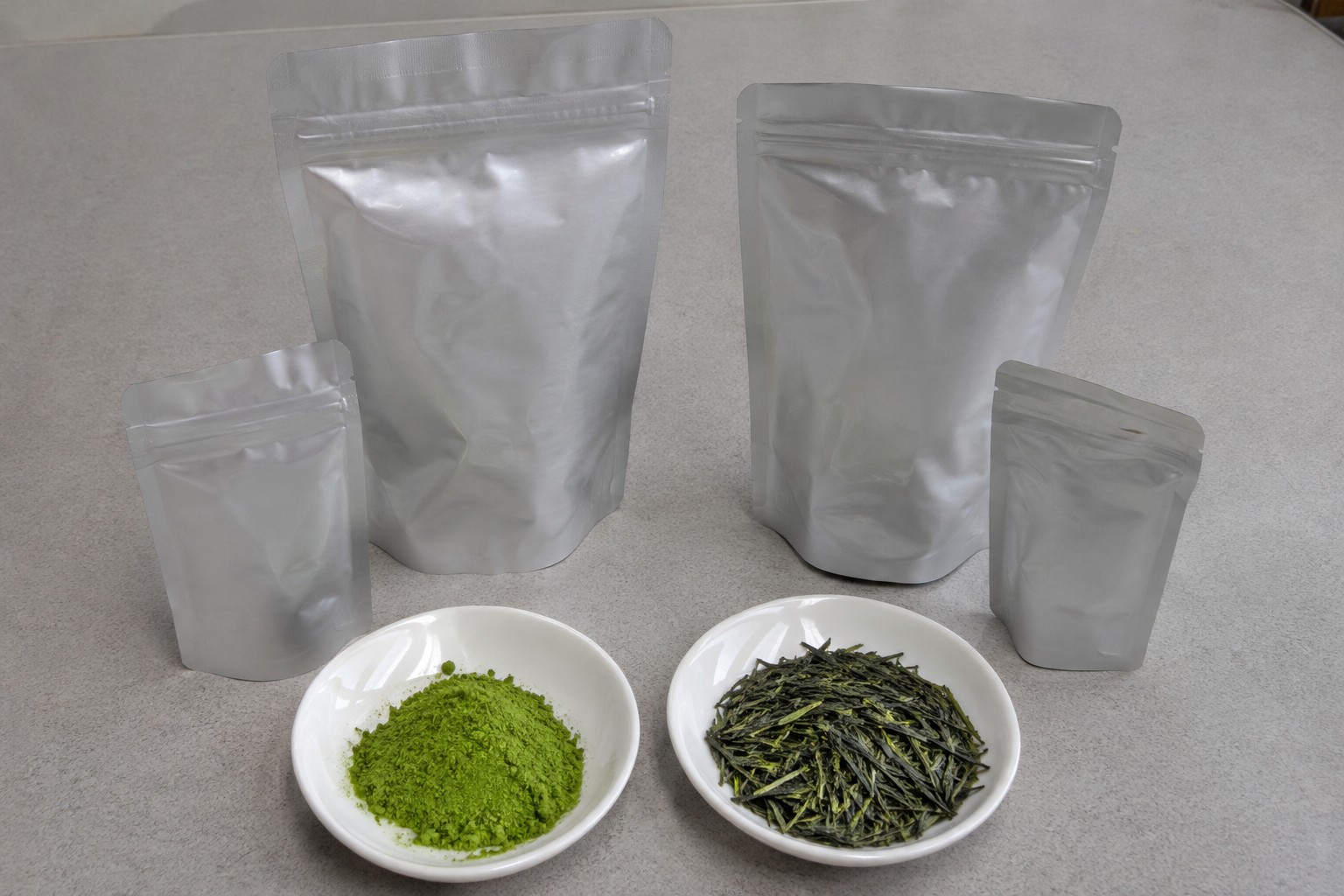
A 100 g bag of matcha is a small object. A 100 g bag of sencha is not, and a 100 g bag of roasted leaf is larger again. Leaf traps air and refuses to settle, so the bag has to be chosen from the space the product occupies.
You cannot do that from a size chart. Weigh out the fill weight you are planning, tip it loosely into a kitchen measuring jug without pressing it down, and tell us the millilitres with the grams. Two minutes of that saves a wrong bag.
| Fill weight | Net leaf for 500 bags | What it tends to suit |
|---|---|---|
| 20 g | 10 kg | Trial size, a few pots |
| 50 g | 25 kg | The common retail size |
| 100 g | 50 kg | Regular drinkers, gift size |
| 500 g | 250 kg | Cafe & food service |
Those are net weights, meaning what ends up inside the bags. Filling to a target weight leaves a little behind, so send a margin and tell us the shipping weight with the bag count so we can confirm it is comfortable.
Leaf weighs less precisely than powder
A powder flows and settles, so a filler can hit a target weight closely. Leaf does not: the pieces are large relative to the target, they bridge, and the last fraction of a gram arrives as a whole leaf or not at all.
The practical consequences are two. Overage is larger than for a powder, so the margin you ship on top of the bare multiplication needs to be bigger. And very small fill weights are harder, because a 3 g target made of 100 mg pieces is a coarser instrument than it sounds.
If your leaf is unusually large, unusually fragile or has a high proportion of stem, tell us before you ship. Where there is a real question about how a material feeds, we will say we need it in hand to answer rather than guessing on the day.
Whole leaf, cut leaf and fannings behave differently
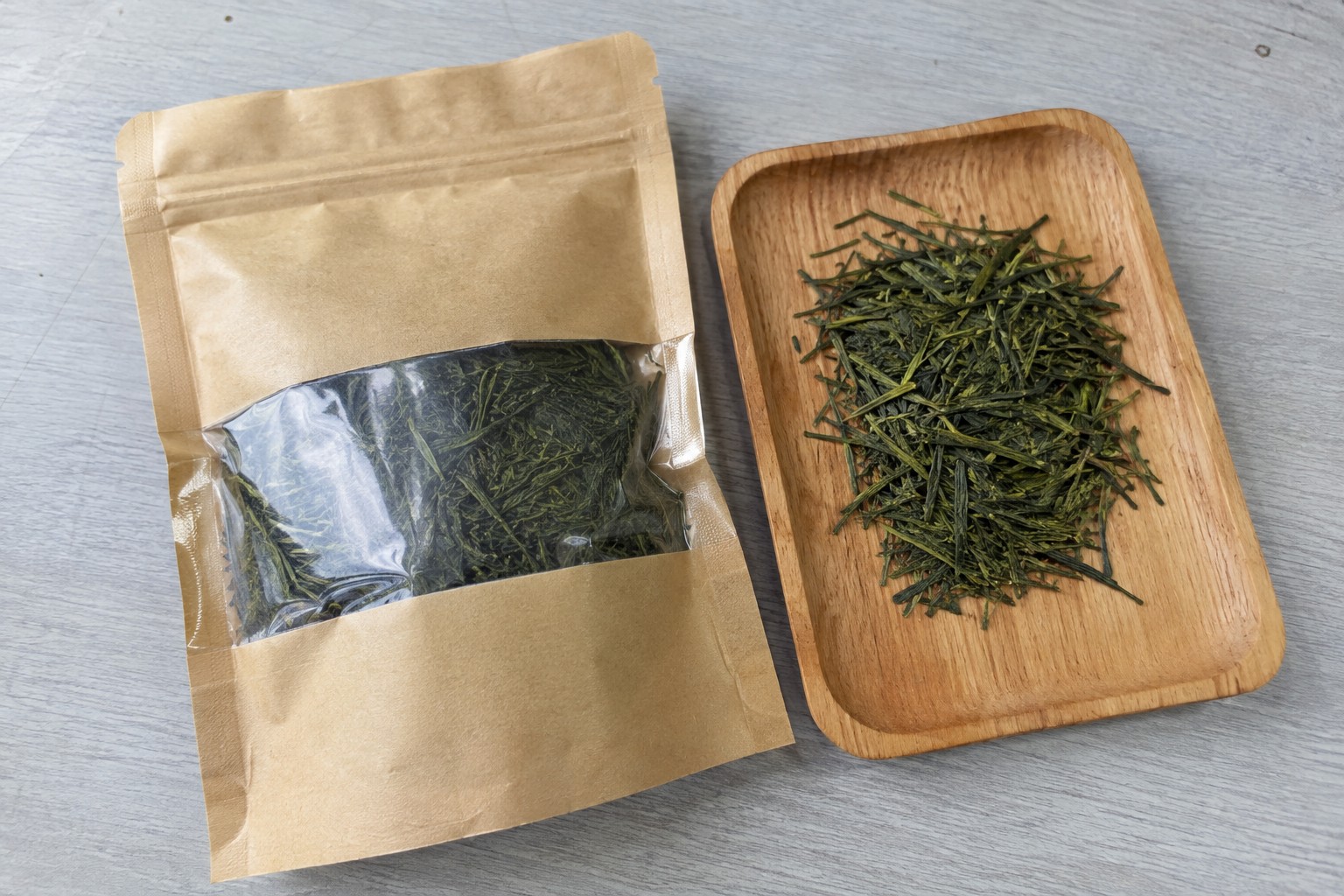
Whole leaf is the bulkiest and the least precise. Cut leaf is the easiest of the three and the most common retail form. Fannings and dust behave more like a powder, which makes them straightforward to weigh and a poor fit for a clear bag.
Say which one you have in the first message. It changes the bag, the margin and sometimes the answer.
A window is worth paying for
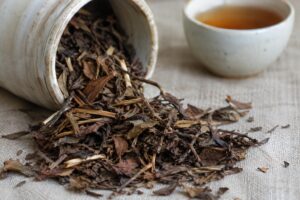
Unlike a powder, leaf sells itself by appearance. A customer who can see a well rolled sencha or a glossy roasted leaf is being given a reason to pick it up, and a fully opaque bag throws that away.
The compromise most brands land on is a stand up pouch with a window: enough barrier to be sensible, enough glass to show the product.
| Code | Option | Size | Per piece |
|---|---|---|---|
| PKG-001 | Clear stand up pouch with zipper, white, window | 120 by 200 mm | USD 0.45 |
| PKG-003 | Clear stand up pouch with zipper, white, window | 140 by 220 mm | USD 0.50 |
| PKG-007 | Clear flat pouch with zipper, light goods | 140 by 230 mm | USD 0.30 |
| PKG-008 | Clear flat pouch with zipper, light goods | 170 by 260 mm | USD 0.35 |
| PKG-010 | Biomass metallised kraft stand pouch with zipper | 180 by 240 mm | USD 0.60 |
The two described as light goods are worth noting: that is exactly what leaf is, a lot of volume for very little weight. The complete stock list has all 25 items.
A zipper matters more for leaf than for most products, because a bag of tea gets opened dozens of times. We fill and heat seal in ambient air, with no nitrogen flushing and no vacuum on any format, so a resealable top is the practical answer rather than an atmosphere.
The brewing bag is the other format
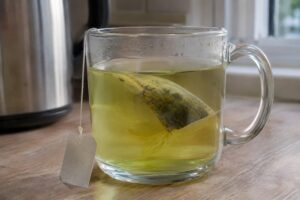
Leaf is the only material on our list that has a genuine second format: the tagged mesh filter at 65 by 80 mm, USD 0.25 a piece. It is also one of the few items genuinely hard to buy in small quantities elsewhere.
The arithmetic is not what people expect, because our minimum counts filled filters and a retail carton holds twenty of them. The filter bag article works it through properly before you plan around it.
Running both on one order is the usual answer. The 500 is a total, so 300 retail pouches plus 200 filters is one order, one set up fee, one shipment.
A worked first order
Five hundred retail bags of 50 g cut leaf, a clear stand up pouch with a zipper and a window, one front label, twenty five kilograms of leaf from your producer.
| Line | Unit | 500 bags |
|---|---|---|
| Fill & seal | USD 0.65 per bag | USD 325.00 |
| Clear stand pouch with window, 120 by 200 mm | USD 0.45 per piece | USD 225.00 |
| Label application, one position | USD 0.15 per position | USD 75.00 |
| Set up fee, first order only | USD 130 once | USD 130.00 |
| Dispatch handling | USD 2.55 per shipment | USD 2.55 |
| Total, first order | USD 757.55 | |
| Per bag, first order | USD 1.52 | |
| Per bag, repeat orders | USD 1.26 |
The window pouch is the most expensive part of that after the filling, and it is the line worth examining if the number is uncomfortable. A clear flat pouch with a zipper at USD 0.30 brings the first order total to USD 682.55 and the per bag figure to USD 1.37, at the cost of shelf presence.
Larger bags, for gifts and food service
Leaf sells in bigger formats than powder does, and the stock list runs up to the aluminium Lamizip at 340 by 240 plus 70 mm for USD 1.85 a piece. That is a serious bag for a serious quantity, and at 500 units it is USD 925 of packaging against USD 325 of filling.
Which is the general rule for leaf in one line: the bag is usually the biggest number on the quotation, and the fill rate is the part that does not move.
What we do not do to it
We do not blend, we do not roast, we do not sort or grade. Hojicha is the clearest example: the roast is the product, it is decided by your producer, and it is fixed by the time the leaf ships to us.
If your product is leaf plus a second finished component, we can weigh both into one bag at USD 1.10 a bag instead of USD 0.65, to a ratio you specify. Deciding the ratio is a contract manufacturer’s job, not ours.
What to tell us when you ask
- Whole leaf, cut leaf or fannings.
- The fill weight per bag and the total bag count.
- The volume the fill weight occupies, in millilitres.
- Whether a brewing filter is part of the range.
- The date you need finished stock in your own warehouse.
Rates, minimums and conditions are on the contract packing page.
Questions we get asked
Why does my 100 g tea bag need to be so large?
Because leaf is mostly air. At the same weight it occupies several times the space of a powder, so the bag is chosen from volume rather than from grams.
How much extra leaf should I ship?
More than for a powder. Leaf weighs less precisely, so the overage is larger. Tell us the shipping weight with the bag count and we will say whether it is comfortable before you book freight.
Can you do a 3 g single serve of leaf?
Usually better as a brewing filter than as a sachet. At that weight the pieces are large relative to the target, and a tagged filter is a more useful object to the customer anyway.
Clear bag or opaque?
A window, in most cases. Appearance sells leaf, and we add no atmosphere inside the bag, so some barrier plus a zipper is the sensible middle.
Can you blend two teas?
Not as a recipe. Send both finished with the grams of each and we weigh them into one bag at USD 1.10. Working out the blend is not something we do.
Related reading
- Tea filter bags in small quantities
- Hojicha, and why the roast makes it cheap to bag
- Stock bags and what each one costs per piece
- Who sells you the tea, and who bags it
Tell us the cut, the fill weight and the volume it occupies. That is enough to pick the bag and price the run. WhatsApp reaches us fastest, and we answer in English. If you would rather not use it, the enquiry form does the same job.
Message us on WhatsApp Use the enquiry form Agriture Inc., Kyoto, Japan- Sampling at a Trade Show: How Many, What Size, How Early
- Organic, Halal, Vegan: the Claims We Cannot Certify
この記事を書いた人
関連記事
-
 Organic, Halal, Vegan: the Claims We Cannot Certify
-
What Goes on the Label, and Who Supplies It
-
Boxed Sets and Multi Packs: the Count That Decides Everything
-
Private Label Matcha: Who Sells You the Tea, and Who Bags It
-
Hojicha Is the Easy One to Bag, and the Roast Is Why
-
Tea Filter Bags in Small Quantities, and the Arithmetic Nobody Expects
-
Pack It in Japan, or Ship It Home in Bulk and Pack It There
-
Dried Shiitake: the One Where the Customer Wants to See It