How to Find a Contract Packer in Japan From Outside Japan

Finding a company in Japan to put your product into retail bags is harder than it should be, and almost none of that difficulty is about the work itself. It is about discovery. The firms that do this are small, they sell to Japanese customers, and most of them have no English page at all.
We are one of them, so take this as a practitioner’s account rather than a neutral guide. The process below is what works, including the parts that lead somewhere other than us.
目次
Why the search is hard
Three reasons, and knowing them changes how you look.
- The vocabulary does not translate cleanly. A Japanese packing line is a jutaku kako company, which renders as contract processing, and that phrase covers drying, milling, blending and bagging as though they were one trade. They are not.
- Prices are almost never published. A published rate card is unusual in this industry in Japan, which means comparison shopping by browsing does not work.
- Most firms have no English site. The ones that do are often trading companies selling other people’s capacity, which is a different relationship with a margin in it.
The practical effect is that you cannot shortlist by searching. You have to shortlist by asking, and the quality of your question decides the quality of the list.
Separate the four jobs before you start
The single most common waste of a month is approaching the wrong kind of company. Four distinct trades get called contract processing in Japan.
| What you need | Who does it | Minimum is set by |
|---|---|---|
| Grow it, dry it, mill it | Your producer | Their own production |
| Develop a recipe, blend to a formula | A contract manufacturer | A production batch |
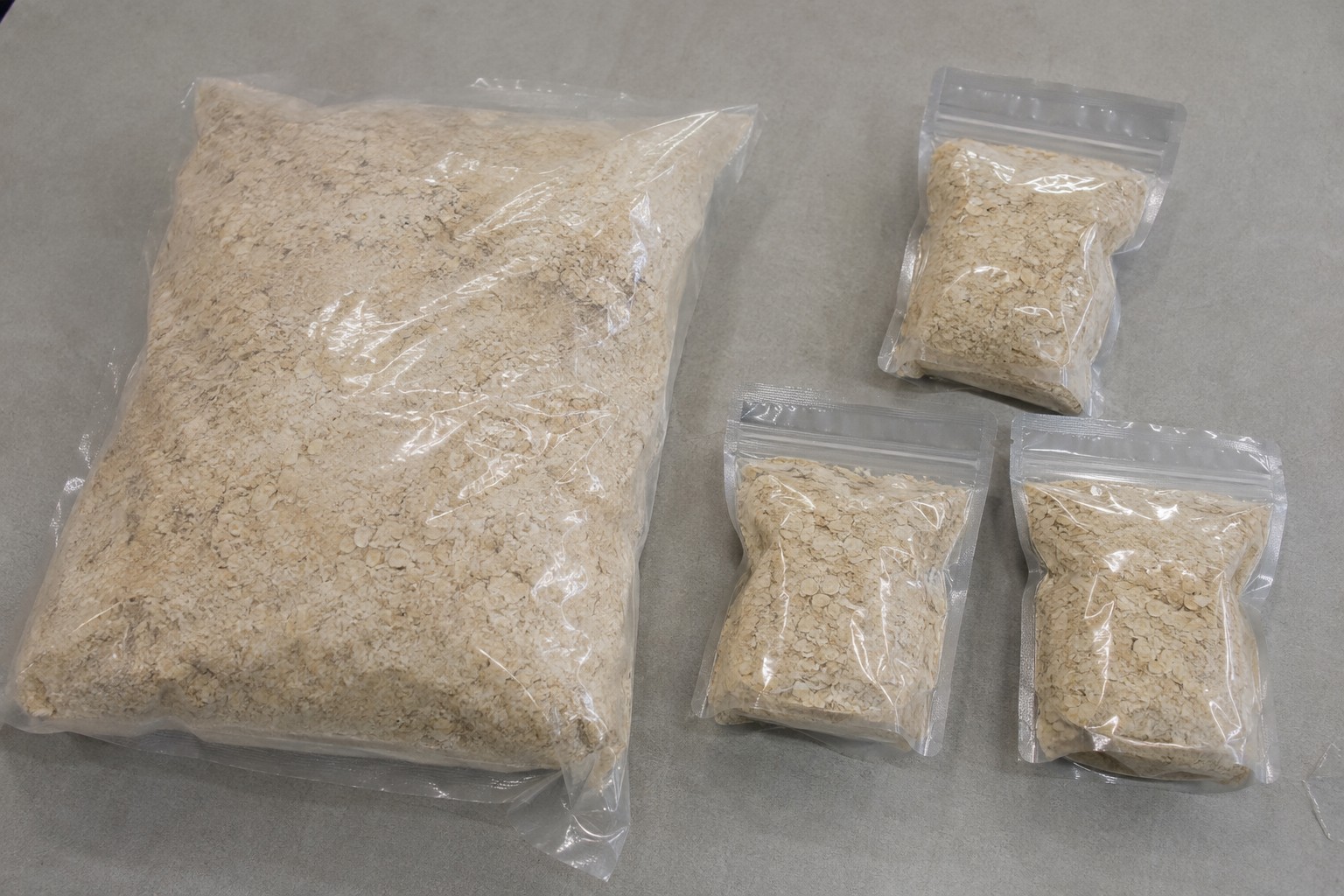
| Weigh a finished product into retail bags | A packing line, which is us | A bag count |
| Buy on your behalf, then arrange the rest | A trading company | Their own commercial view |
If your material is already finished and you need it in bags, you want the third row. If any part of the material still has to be made, you want the first or second. A packer is not a manufacturer sets out the boundary in detail, including the requests we have to decline.
What to put in the first email
Japanese suppliers quote literally. A vague enquiry gets a vague answer, or no answer, and that is not rudeness. It is an inability to price a question that has not been asked precisely.
Four lines are usually enough to get a real number back.
- What the material is, and confirmation that it is finished and dry.
- The fill weight you want in each bag.
- The total bag count across the order.
- The date you need finished stock in your own warehouse.
Add the bag if you have chosen one, and say plainly whether the material is already in Japan or has to be imported. That last point changes the answer more than anything else on the list, because it brings in approvals that take longer than the packing does.
What to leave out
Long company introductions, brand decks and market opportunity framing. They do not help a packing line price a run, and in an industry where most enquiries are two paragraphs of specification, a four page attachment reads as somebody who has not worked out what they want yet.
Also leave out the request for a call before any specification has been exchanged. Most of these companies would rather answer in writing, in their own time, correctly.
The questions that qualify a packer quickly
Ask these early. Each one rules something in or out, and together they take about one exchange.
| Ask | Why it matters |
|---|---|
| What is your minimum, in what unit | Bags, kilograms, a run charge. The unit tells you who they are |
| Is the minimum per product, / per order | Per order lets you launch a range. Per product rarely does |
| Is there a minimum fill weight | A line that insists on one cannot do sachets |
| Do you hold stock bags, at what prices | Holding stock means no print run on a first order |
| Ambient only, / chilled as well | Rules out a lot of projects immediately |
| Can you gas flush, / vacuum seal | Decides which products are viable |
| Who is the importer of record | If they say they will handle it, ask again |
| What is the lead time, from what moment | From order, / from material arriving, are different |
Our own answers, for calibration: 500 bags per order, counted across the whole order, no minimum on fill weight, 25 stock bags from USD 0.10 to USD 1.85, ambient only, no gas flushing and no vacuum, you are the importer, three to four weeks from the day the order is confirmed with your material already in Kyoto.
Signals worth paying attention to
Not red flags exactly, but things that tell you what kind of company you are talking to.
- A quotation that prices exactly what you asked and nothing else is a good sign. It means somebody read the question.
- A supplier who tells you a thing is difficult is almost always saying no politely. Ask what would have to be true instead.
- A supplier who offers to handle your import without asking where your company is registered has not thought about it. A company with no address in Japan needs a Customs Procedure Agent filed with customs first.
- A long silence usually means your question could not be priced, not that you are being ignored. There is a whole article on that.
- Published rates are rare enough in this industry that they tell you something about how the company prefers to work.
What a quotation should look like
You can tell a lot about a packing company from the shape of its quote, before you compare a single number.
| A good sign | A reason to ask more |
|---|---|
| Each line priced separately | One bundled project fee |
| A unit price with a quantity | A total with no arithmetic shown |
| A validity period on the document | No expiry, which usually means no thought |
| Freight stated separately, / left out | Freight folded into the unit price |
| The minimum stated in a unit you can plan with | A minimum that moves when you push |
The reason the itemised version matters is that it lets you change one thing without reopening everything. A quote that prices the bag separately from the filling lets you try a cheaper bag. A single bundled number does not.
Freight folded into a unit price is the one worth questioning hardest. It depends on a carrier plus a destination the packer has not chosen, so a firm quoting it inside the bag price is either guessing or carrying a margin you cannot see.
Getting the material there is the other half
A packing line in Japan is only useful to you if your material can reach it. If your producer is already in Japan that is a domestic pallet and there is nothing to arrange. If the material is coming from outside Japan it is an import in your name, with two approvals in front of it.
Sending your material to a Japanese packer covers both: the Customs Procedure Agent a non resident has to appoint, and the food notification that goes to the quarantine station rather than to customs. Neither is quick to arrange once material is already in the air, and a packer who does not mention them is not the one who will be dealing with them.
What to tell us when you ask
- What the material is, and that it is finished and dry.
- The fill weight per bag and the total bag count.
- Whether the material is already in Japan.
- Whether you want a stock bag or are supplying printed bags yourself.
- The date you need finished stock in your own warehouse.
Our rates, minimums and conditions are published in full on the contract packing page, so you can rule us in or out before you write anything at all.
Questions we get asked
Why can I not find prices anywhere?
Published rate cards are unusual in this industry in Japan. Most firms quote on request, which makes comparison slow. Ours are published, which is the main reason overseas brands find us at all.
Do I need a Japanese company to work with a Japanese packer?
Not with us. You do need to be able to import into Japan in your own name, which for a company with no address in Japan means appointing a Customs Procedure Agent and notifying customs in advance.
Should I use a trading company instead?
If you want one contract covering the material plus the packing, yes, and say so plainly in your first email. It costs more because somebody is carrying the material risk, and they usually have a view about which material you should buy.
How long should I wait for a reply?
A few working days is normal. If a week passes, the usual cause is that the enquiry could not be priced as written. Resend it with the four lines above.
Is it cheaper to pack in Japan at all?
At low volume, usually. At high volume, usually not, and we say so. The comparison with packing near your own market has our own numbers on both sides.
Related reading
- A first packing order, step by step with the dates
- A packer is not a manufacturer
- Why your Japanese supplier has not replied
- Pack in Japan, or ship bulk and pack at home
- What a 500 bag minimum really means
Send the four lines and we will price it. Material, fill weight, bag count, date. WhatsApp reaches us fastest, and we answer in English. If you would rather not use it, the enquiry form does the same job.
Message us on WhatsApp Use the enquiry form Agriture Inc., Kyoto, Japan- Sakura: the Form It Arrives In Decides Whether We Can Run It at All
- Why Your Japanese Supplier Has Not Replied
この記事を書いた人
関連記事
-
 Organic, Halal, Vegan: the Claims We Cannot Certify
-
What Goes on the Label, and Who Supplies It
-
Boxed Sets and Multi Packs: the Count That Decides Everything
-
Private Label Matcha: Who Sells You the Tea, and Who Bags It
-
Hojicha Is the Easy One to Bag, and the Roast Is Why
-
Tea Filter Bags in Small Quantities, and the Arithmetic Nobody Expects
-
Pack It in Japan, or Ship It Home in Bulk and Pack It There
-
Dried Shiitake: the One Where the Customer Wants to See It