Kinako in Retail Bags: What an Overseas Brand Decides First

Kinako is roasted soybean flour, and it is having a moment outside Japan. It is the dusting on warabi mochi, it goes into lattes and ice cream, and for a brand building a Japanese pantry range it is an obvious second or third product after matcha.
It is also the product where the bag decision is least obvious, because kinako does not behave like other powders on a filling line. Here is what to settle before you ask anyone for a quote.
目次
The product arrives finished
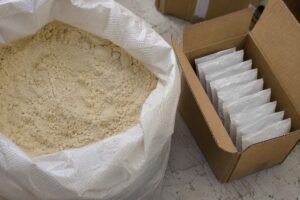
We do not roast and we do not mill. Both of those steps are what make kinako kinako, and they belong to your producer. What reaches our line in Kyoto is finished flour, ambient, in sealed bulk bags, ready to weigh into retail packaging.
Roast level is fixed before it ships
That matters when you are choosing a supplier, because roast level is the main thing that distinguishes one kinako from another, and it is not something a packing line can adjust for you. Settle the roast with your producer and treat it as fixed by the time it ships. The whole boundary is set out in what a packer will not do.
Light for its volume, and the grind is not a given
Kinako is light for its volume. A bag that comfortably holds 100 g of a dense dried vegetable powder will not necessarily hold 100 g of kinako, because the same weight takes up more room. This is the surprise worth heading off on a first kinako order, and it is discovered at the worst possible moment: with the material in Kyoto, the bags bought and the run scheduled.
How fine it is, though, is not a property of kinako. It is a decision your producer already made. Some mill it to a flour as fine as matcha, others leave it coarse enough to feel grainy, and plenty sit somewhere in the middle. The spread is wide enough to change which bag works and how the material behaves on the line, so tell us the grind as well as the fill weight when you first ask.
So do it the other way round. Tell us the fill weight you want, the grind, and the bag you are considering, so all three can be checked against each other before anything is ordered. If you are supplying your own printed bags, raise it early, because a print run cannot be undone.
Grind also decides how it runs
A very fine kinako behaves like matcha, which is to say it is slower and more prone to packing down; a coarse one flows more like a cut ingredient. Tell us up front if yours is at either extreme, or if it has shown any tendency to clump in storage. Where there is a real question about how it flows we will say we need the material in hand to answer it instead of guessing on the day.
Formats and what 500 bags needs
Our minimum is 500 bags per order and the fill price is flat at any gram weight, so the format decision is about the shelf.
| Bag size | Net flour in 500 bags | What it suits |
|---|---|---|
| 20 g | 10 kg | Single use / trial sachet |
| 50 g | 25 kg | Small retail, dusting size |
| 100 g | 50 kg | The common retail format |
| 200 g | 100 kg | Family size, repeat buyers |
| 500 g | 250 kg | Cafe & food service |
Those are net weights, so add a margin on top: filling to a target weight leaves a little in the machine, and 50 kg shipped will not give you 500 full 100 g bags. Send us the shipping weight with the bag count and we will confirm it before you book freight.
The 100 g format is where kinako gets heavy, and it is worth seeing the three ingredients side by side at the same 500 bag count. Kinako at 100 g needs 50 kg. Matcha at its usual 30 g retail size needs 15 kg. Yuzu at 10 g needs 5 kg. So the same minimum order is a ten kilogram commitment in one product and a fifty kilogram one in another, purely because of the shelf format each ingredient sells in.
If fifty kilograms is more material than you want to commit to on a first order, the way down is not a smaller order, it is a smaller bag. Five hundred bags of 50 g needs half the flour and sells at a lower shelf price.
The count is also a total across the order, so a 100 g retail bag plus a 20 g sachet can share one run and one set up fee. The 500 bag minimum has the three usual ways to reach the number without buying more material.
Bag choice, when the colour is worth showing
Kinako is a pale, warm beige, which photographs well and looks like what it is. That gives you a genuine choice.
| Option | Size | Per piece | Why |
|---|---|---|---|
| Clear stand up pouch with zipper, window | 120 by 200 mm | USD 0.45 | Shows the colour, holds a shelf |
| Biomass metallised kraft stand pouch with zipper | 180 by 240 mm | USD 0.60 | Barrier plus a paper face, suits the traditional positioning |
| Aluminium stand up pouch with zipper | 130 by 130 mm | USD 0.30 | Most protection. Small bag, so 20 g to 50 g of kinako, not 100 g |
| Clear flat pouch | 120 by 140 mm | USD 0.15 | Sachets, refills, anything sold in a box |
A zipper is worth more on kinako than on most products, because it is used a spoonful at a time over weeks. We fill and heat seal in ambient air with no gas flushing on any format, so a resealable barrier bag is the practical answer here. The stock bag list has the main options with prices.
The soy declaration
Kinako is made from soybeans, and soy is a declared allergen in many markets. Whether yours is one is a question for your broker, and so are the wording, the format and the placement, which are set by the rules where the product is sold. We are a packing line, not a labelling consultancy, so this is one to confirm properly rather than to copy from another brand’s bag.
What we can do is apply what you supply. Labels are USD 0.15 per position and a back label counts as its own position, so a front label plus an ingredients and allergen panel on the back is USD 0.30 a bag. For a 500 bag run that is USD 150, which is almost always cheaper than printing the information onto the bag itself at this volume.
If your market requires anything about where the product was packed, the difference between packed in Japan and product of Japan covers why bagging in Kyoto is not the same as the product being Japanese.
The one thing we cannot do
Stick packs. A single serve kinako stick to go with a coffee or to drop into a drink is a good idea and it is the one format our equipment genuinely cannot run. If a single serve is central to your concept, the alternative within our range is a small flat pouch or a three side seal sachet, which does the same job with a different silhouette.
We also do not run refrigerated or frozen handling, do not provide laboratory analysis, and do not act as importer of record for material coming into Japan.
What to ask your producer, before you ask us
Three things about kinako are fixed upstream, and all three change what we quote. Settle them before you send us a specification.
- The roast. It is the single thing that distinguishes one kinako from another, and it cannot be adjusted at a packing line.
- The grind. Ask for it as a number if your producer has one, or as a comparison if not: closer to matcha, or closer to a coarse meal.
- Whether it is pure soy flour or already sweetened. A sweetened kinako is a different product with a different declaration, and if you want us to combine plain kinako with sugar that is a measured mix at USD 1.10 a bag rather than a recipe we develop.
With those three answers plus a bag count we can price a run. Without the grind in particular we are guessing at which bag suits your fill weight, and that is the guess that gets expensive once printed bags are involved.
What to tell us when you ask
- The fill weight you want, and the bag you are considering, so we can check the volume works.
- The total bag count across every format in the order.
- How many label positions, front only or front and back.
- Whether you are supplying bags or using our stock.
- When the flour will reach Kyoto, and when you need finished stock.
Lead time is three to four weeks from the day the order is confirmed and the material has arrived. Rates, minimums and the full stock list are on the contract packing page.
Questions we get asked
How fine is kinako?
It depends entirely on your producer. Some mill it as fine as matcha, others leave it coarse enough to feel grainy. The spread changes which bag works and how the material runs, so tell us the grind as well as the fill weight.
Why does kinako need a bigger bag than I expected?
It is light for its volume. A bag that comfortably holds 100 g of a dense dried vegetable powder will not necessarily hold 100 g of kinako, because the same weight takes up more room.
How much flour does a 100 g retail launch need?
Fifty kilograms net for 500 bags, plus a margin. At the same bag count matcha at 30 g needs fifteen kilograms and yuzu at 10 g needs five, which is the clearest illustration of how much the shelf format drives the material commitment.
Can you roast the soybeans?
No. The roast is the main thing that distinguishes one kinako from another and it is fixed by your producer before it ships.
Can you make a sweetened kinako?
Only as a measured mix. Send plain kinako plus sugar with the grams of each and we weigh both into the bag at USD 1.10. Working out the ratio is not our job.
Related reading
- Hojicha, and why the roast makes it cheap to bag
- Stock bags and what each one costs per piece
- Yuzu, where the harvest sets your window
- Packed in Japan or product of Japan
- What a 500 bag minimum really means
Send the fill weight and the bag you have in mind. We will confirm the weight fits before anything is ordered. WhatsApp reaches us fastest, and we answer in English. If you would rather not use it, the enquiry form does the same job.
Message us on WhatsApp Use the enquiry form Agriture Inc., Kyoto, Japan- Yuzu Powder: the Harvest Sets Your Window, Not Your Launch Date
- Packed in Japan or Product of Japan: Two Different Claims
この記事を書いた人
関連記事
-
 Organic, Halal, Vegan: the Claims We Cannot Certify
-
What Goes on the Label, and Who Supplies It
-
Boxed Sets and Multi Packs: the Count That Decides Everything
-
Private Label Matcha: Who Sells You the Tea, and Who Bags It
-
Hojicha Is the Easy One to Bag, and the Roast Is Why
-
Tea Filter Bags in Small Quantities, and the Arithmetic Nobody Expects
-
Pack It in Japan, or Ship It Home in Bulk and Pack It There
-
Dried Shiitake: the One Where the Customer Wants to See It