Pack It in Japan, or Ship It Home in Bulk and Pack It There

Every brand sourcing a Japanese ingredient faces the same fork. Have it bagged in Japan and ship finished retail units, or ship the material home in bulk and have it bagged near your own market.
We only do one of those, so treat what follows accordingly. It is still worth writing down, because the answer is genuinely different at different volumes, and brands who pick wrong usually picked without doing the arithmetic.
目次
What each option actually is
| Bagged in Japan | Bagged near your market | |
|---|---|---|
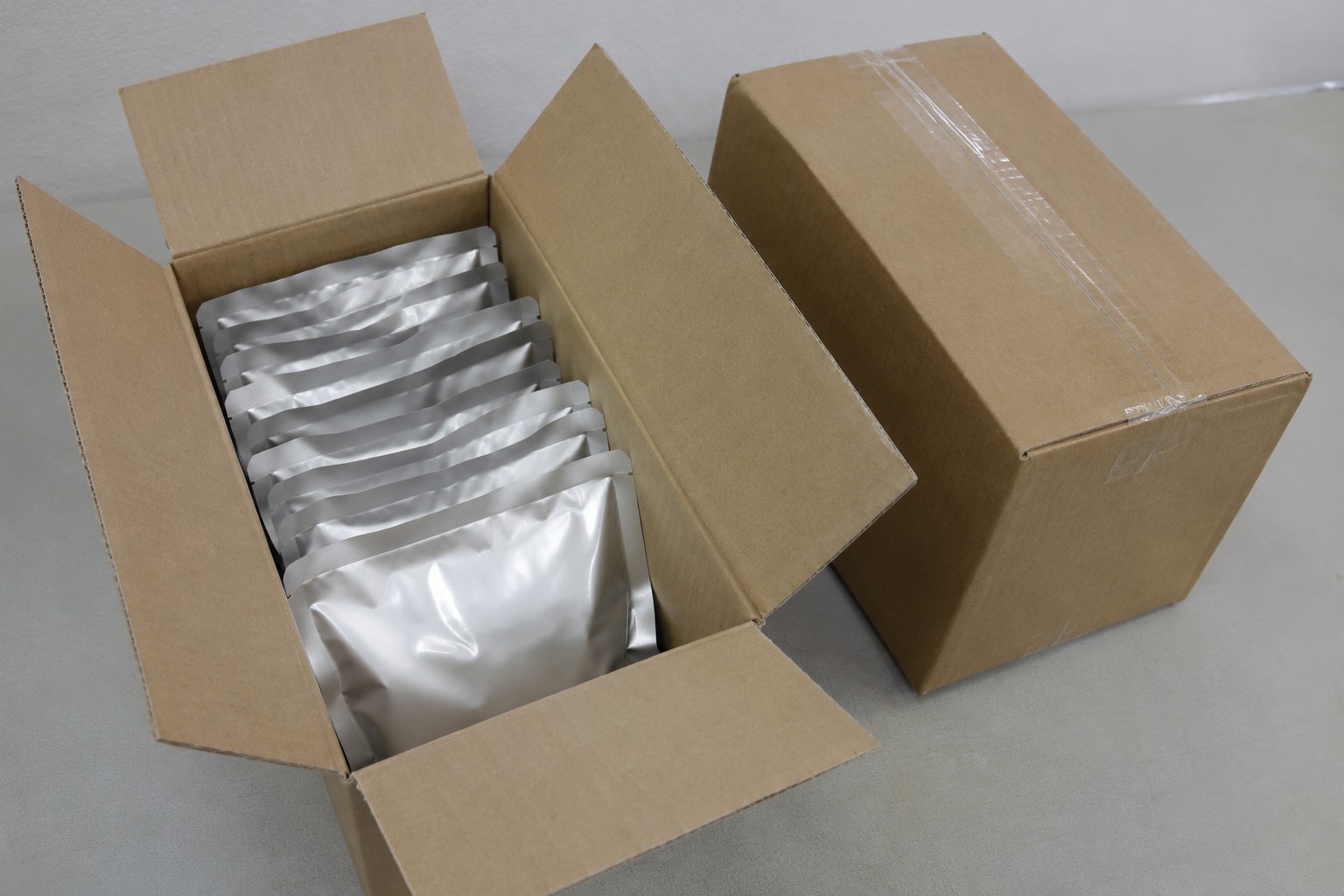
| What crosses the border | Finished retail units in cartons | Bulk material, usually 1 kg to 20 kg sacks |
| Who carries the minimum | Us. 500 filled bags per order | Your local co-packer. Ask them. It is often much higher |
| Freight pays for | Product plus air inside the bags | Product, densely packed |
| Labelling | Done before it ships, in Japan | Done at home, close to the rules you sell under |
| Reacting to demand | Three to four weeks plus a sea leg | As fast as your co-packer can schedule |
The case for bagging in Japan
It wins on three things, and they all matter most at low volume.
The minimum is small
Our minimum is 500 filled bags, counted across the whole order, including a mix of sizes and products. Ask a co-packer near you what theirs is. The answer is often expressed in thousands of units per SKU, or in a minimum run charge that works out the same way, and for a brand launching three flavours it is frequently the thing that kills the plan. The 500 bag minimum explains why ours is counted in bags rather than weight.
Nothing gets handled twice
A bulk sack opened and re-bagged at home is an extra handling step, an extra facility, an extra set of people who have to be told how your product behaves. For a fine powder in particular that step is not free, and it is where loss and contamination risk live.
The packed in Japan fact exists
Bagging in Japan is a fact about your product that you can state truthfully. It is not an origin claim and it does not make the contents Japanese, which is a distinction worth getting right before it goes on artwork. Packed in Japan or product of Japan is the article on exactly that.
The case for bagging near your market
It wins on two things, and they both get stronger as you grow.
Freight on finished goods is freight on air
This is the real cost that catches people. A retail bag is mostly empty space. Ship 500 bags of 30 g and you are paying to move fifteen kilograms of tea inside cartons sized for five hundred pouches. Ship the same fifteen kilograms in bulk and it occupies a fraction of the volume.
At 500 bags this is a rounding error against the rest of your costs. At fifty thousand bags it is a line item somebody will eventually point at, and they will be right.
You can respond to demand
Stock bagged in Japan is committed. The format is fixed, the label is on, and changing your mind means a new run plus a new sea leg plus whatever the Japanese factory calendar does to the dates. Three weeks a year nothing ships covers that last part, which is larger than most people plan for. Bulk material sitting near your market can become whatever format sells.
Where the line falls
There is no universal number, because it turns on your local co-packer’s minimum more than on anything we charge. But the shape of it is consistent.
| Situation | Usually better |
|---|---|
| First order, testing a market | Japan. Nobody local will quote 500 units |
| Several formats, small quantities each | Japan. The 500 is one total |
| One product, high volume, stable demand | Near your market |
| Format changes often, demand is spiky | Near your market, from bulk stock |
| Material needs cold chain | Neither of us. We hold ambient only |
The pattern is that Japan wins while you are small or uncertain, and loses once you are large and predictable. That is not a sales pitch and we are not going to pretend otherwise. Plenty of brands start here and move the packing closer to home in year three, which is the correct decision when it happens.
Put our side of it in numbers
Half a comparison is easy to publish, so here is ours in full, for a 30 g powder in a stock aluminium pouch with one label. Take these to whoever is quoting the other side and ask for the same lines back.
| Line | 500 bags | 10,000 bags |
|---|---|---|
| Fill & seal, USD 0.65 each | USD 325.00 | USD 6,500.00 |
| Aluminium pouch, USD 0.30 each | USD 150.00 | USD 3,000.00 |
| Label, one position, USD 0.15 each | USD 75.00 | USD 1,500.00 |
| Set up fee, first order only | USD 130.00 | USD 130.00 |
| Dispatch handling | USD 2.55 | USD 2.55 |
| Total, first order | USD 682.55 | USD 11,132.55 |
| Per bag | USD 1.37 | USD 1.11 |
That bottom row is the honest part of this article. Our per unit cost barely moves with volume: USD 1.37 at five hundred, USD 1.11 at ten thousand, and the whole difference is the set up fee spreading out. There is no volume discount on filling here, because the labour per bag is the same bag after bag.
A packing operation near your own market, running a long line for a day, will eventually beat that. It has to, because its cost per unit falls with scale in a way ours does not. Add the freight saving on bulk and the gap widens further. So if your plan is ten thousand units a month of one stable product, the arithmetic is not on our side, and you should know that before you ask us.
What we are good at is the first ten thousand, spread over three products and two years, while you find out which one sells. That is a real job and it is badly served elsewhere, which is why the minimum is where it is. It is not an attempt to win the volume work, and a supplier who tells you otherwise about their own line is worth a second look.
The question that settles it
Ask your local co-packer to quote your actual first order, at the quantity you actually want, with the number of distinct products you actually plan to launch. Not a comfortable round number. Not an annual volume.
That one question resolves most of this article, because the answer is usually either a workable price or a polite explanation of why the minimum is higher. Both are useful. What is not useful is comparing our published rate against a local quote for ten times the quantity, which is the comparison brands most often make by accident.
The hybrid most people land on
Bag the retail formats in Japan while the volumes are low, and move to bulk plus local packing for the one product that turns into a real seller. The two are not exclusive, and the switch does not have to be all at once.
The thing to avoid is the reverse: committing to a large local packing run before you know which of your products sells. That is the expensive mistake, and it is the one our minimum exists to let you skip.
One detail worth building in from the start: keep your producer able to supply both ways. A producer set up only to ship you 1 kg foil bags for our line may need notice to supply 20 kg sacks for a bulk shipment later, and the reverse is also true. Ask them early what both look like, because the switch is much easier when it was always on the table.
What to work out before you decide
- Your local co-packer’s real minimum, per SKU, in writing.
- The freight cost of finished cartons compared with the same material in bulk, quoted by your forwarder for your actual lane.
- What your label has to say, and whether it is easier to apply that in Japan or at home.
- How often you expect the format to change in the first two years.
- Who does the handover inside Japan if you do bag here. Our part ends in Kyoto covers that leg.
Our own rates, minimums and conditions are published on the contract packing page, so you can put real numbers on one side of the comparison without asking anybody.
Questions we get asked
Is it cheaper to pack in Japan?
At low volume, usually yes, because our minimum is 500 filled bags across the whole order and most local co-packers quote in thousands per product. At high volume it is usually no, and we will say so.
Why does your price barely fall with volume?
Because the labour per bag is the same bag after bag. The fill rate is USD 0.65 at five hundred and at fifty thousand. Only the one time set up fee spreads out, which takes a 30 g matcha job from USD 1.37 a bag to USD 1.11 across a twentyfold increase.
What makes shipping finished goods expensive?
Retail bags are mostly empty space, so you pay to move air. At 500 bags that is immaterial. At fifty thousand it is a line item somebody will point at.
What should I ask a local co-packer?
For a quote on your actual first order, at the quantity you actually want, with the number of products you actually plan to launch. Not a comfortable round number, and not an annual volume.
Can I do both?
That is what most brands end up doing. Bag the small formats in Japan while volumes are low, and move the one product that becomes a real seller to bulk plus local packing. Keep your producer able to supply both ways from the start.
Related reading
- What a 500 bag minimum really means
- Where our part ends, and the leg after it
- The three weeks when nothing ships in Japan
- Packed in Japan or product of Japan
Tell us the format and the annual quantity. We will tell you honestly whether this is the right side of the comparison. WhatsApp reaches us fastest, and we answer in English. If you would rather not use it, the enquiry form does the same job.
Message us on WhatsApp Use the enquiry form Agriture Inc., Kyoto, Japan- Tea Filter Bags in Small Quantities, and the Arithmetic Nobody Expects
- Where Our Part Ends: the Handover in Kyoto and the Leg After It
この記事を書いた人
関連記事
-
 Organic, Halal, Vegan: the Claims We Cannot Certify
-
What Goes on the Label, and Who Supplies It
-
Boxed Sets and Multi Packs: the Count That Decides Everything
-
Private Label Matcha: Who Sells You the Tea, and Who Bags It
-
Hojicha Is the Easy One to Bag, and the Roast Is Why
-
Tea Filter Bags in Small Quantities, and the Arithmetic Nobody Expects
-
Dried Shiitake: the One Where the Customer Wants to See It
-
Sakura: the Form It Arrives In Decides Whether We Can Run It at All