Sending Your Material to a Japanese Packer

A packing project has two shipments in it. The one everybody plans for is the finished stock leaving Japan. The one that causes the trouble is the first one: getting your material to the line in the first place.
If your producer is already in Japan, that leg is simple. Green tea from Shizuoka, dried fruit from Kyushu, a powder milled in Shizuoka: your producer books a domestic pallet to our line in Kyoto, nothing crosses a border, and there is no customs step at any point.
If the material is coming from outside Japan, it is an import, and the entry is made in your name. That is a different job with two separate approvals standing in front of it, and it is where first shipments actually stop. The rest of this article is mostly about that case. Here is what has to be true before your material can go into a bag.
目次
You are the importer, not us
We are a packer. We are not an importer of record, and we do not clear your goods into Japan. The import entry is made in your own name, or in the name of an agent you have appointed and filed with Japanese customs. Duties plus any inspection costs are yours. Our part starts when the material is physically at our line in Kyoto.
Three different parties get confused here, so it is worth separating them now. The importer is you, and that does not change. The Customs Procedure Agent is a resident of Japan you nominate so that a company with no address here can deal with customs at all, and the nomination is filed in advance. The customs broker is the licensed firm that actually files the declaration. One company can sometimes be two of those, but never by default, and the next section is the one that catches people out.
That is not a technicality, it is the thing to settle first, and for a company based outside Japan there are two separate systems to get through before a pallet can be delivered to us. Neither of them is ours, and neither is quick to arrange once material is already in the air.
If your company is not in Japan, there is a step before the entry
Japan Customs requires a person living abroad to designate someone in Japan before carrying out customs procedures such as an import declaration. The agent is called a Customs Procedure Agent, the designation is notified to the customs office in advance on Customs Form C No. 7500, and it is submitted in two copies. The basis is Article 95 of the Customs Act. The agent has to have an address or residence in Japan; for a company, a head office there.
The part that catches brands out is what the agent is allowed to do. Japan Customs states that a Customs Procedure Agent who is not a licensed customs broker is not permitted to engage, as a business, in customs brokerage services such as filing import declarations. So appointing one company does not automatically cover both jobs. Either you or your agent engages a licensed customs broker as well, or the agent holds a brokerage licence itself.
Expect the notification to want a power of attorney, evidence that your company exists, evidence that the agent exists, and a chart showing the commercial flow of the transaction. Start this before you book freight, not after. We cannot act as your agent and we cannot file on your behalf.
| Customs Procedure Agent | Licensed customs broker | |
|---|---|---|
| What it is | A resident of Japan you nominate | A licensed firm that files declarations |
| Why you need one | A non resident cannot deal with customs without one | Someone has to actually file the entry |
| How it is appointed | Notified to customs in advance, Customs Form C No. 7500 | You engage them commercially |
| Basis | Article 95 of the Customs Act | The Customs Brokerage Act |
| Can one firm be both | Only if it holds a brokerage licence | Yes, if you appoint it as agent too |
| Can we be it | No | No |
Read the bottom two rows together. That is the row pair that costs people time: appointing a single company does not automatically give you both roles, and we cannot fill either of them.
Food has a second notification, at a different agency
This is the one most often missed, because it is not a customs matter at all. Article 27 of the Food Sanitation Act obliges anyone importing food, food additives, apparatus or containers and packaging for sale or for use in business to notify the Minister of Health, Labour and Welfare on each occasion. Matcha, kinako and yuzu powder are food. If you are sending them to us to be bagged for sale, this applies to your consignment.
The notification does not go to customs. It goes to the quarantine station that covers the place where the cargo clears, where a food sanitation inspector reviews it and decides whether the consignment needs testing. If no test is needed, or the result is clear, a certificate of notification is issued. The notification has to be in before customs clearance is finished, and notifications are accepted from seven days before the cargo is due to arrive.
Three consequences for a first shipment. The obligation sits with the importer, which is you, so confirm with your broker and with the quarantine station exactly who is filing it for your shipment, and do not assume it is handled. A first import is more likely to be picked for inspection than a repeat one. And depending on the product the notification can call for a statement of the ingredients plus the manufacturing process, or a test report where a specific standard applies, which is paperwork your producer has to generate, not you.
None of this is our scope, and we are not qualified to advise on it. The reason we raise it at all is that these two steps are where first shipments actually stop, and both are cheap to arrange early and expensive to discover late. Ask us what to put on the paperwork for the domestic delivery leg to Kyoto. Ask your broker and the quarantine station about everything before that point.
The same split applies on the way out. Export freight is booked by your forwarder, and we hand finished cartons over inside Japan. We do not arrange international shipping, so the forwarder relationship is worth having in place before the run finishes rather than after.
The dispatch notice matters more than the paperwork
The single most useful message you will send us is the one that says your material is on its way, with the dispatch date, the carrier and the tracking number. Send it when the material ships rather than when it lands.
This is not bureaucracy. A packing line receives material against a scheduled order, and a pallet that arrives with no notice cannot be matched to one, weighed in or put anywhere sensible. An unannounced arrival, or a quantity that does not match the order, carries a USD 85 charge per case. It is also the easiest charge on our price list to avoid.
Tell us the shape of the delivery too, not just that it is coming. How many cartons, on how many pallets, roughly what they weigh, and whether the driver needs anything specific at our end. Receiving a hundred loose cartons is a different job from receiving two pallets, and knowing which it is in advance means nobody is improvising on the day.
What has to be on the cartons
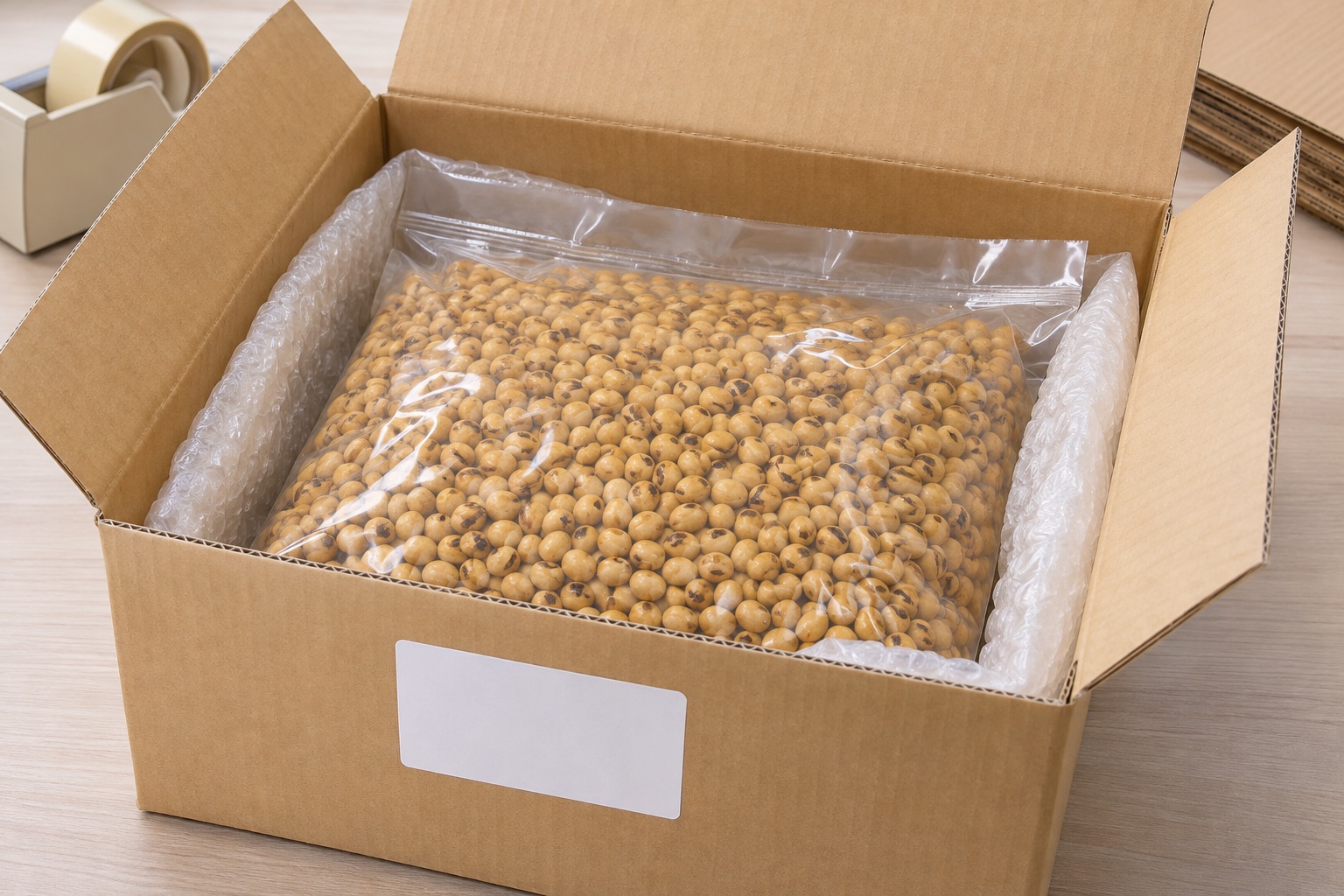
The first thing we do when your material arrives is weigh what turned up against what the order says. That check is only as good as the markings, so three things on the outside of every carton make it quick.
- Net weight of the contents, not just the gross weight of the carton.
- The lot or batch identifier.
- The count, meaning how many inner bags are in that carton and what each one holds.
Keep one lot per carton, or mark clearly where a lot changes. A mixed carton with no internal marking means the receiving check cannot say what actually turned up, and nothing later in the run can rebuild that.
Send more than the arithmetic says
Filling to a target weight always leaves a little material in the machine and in the last part filled bag. If you work out that 500 bags of 30 g needs exactly 15 kg and you send exactly 15 kg, you will not get 500 bags.
Send a margin. How much depends on the material and the format, so tell us the weight you are planning to ship and the bag count you want, and we will say whether it is comfortable before you book the freight. This one question is worth asking before the freight is booked.
Ambient only
We hold and fill dry goods at room temperature. There is no refrigerated or frozen handling at any point, so a material that needs cold chain cannot be packed here at all. If your product is a dried powder, dried pieces or leaf, that is exactly what the line is for.
What the inbound side costs
Three charges touch the material coming in. None of them is freight, which is always yours and always separate.
| Line | Price | When it applies |
|---|---|---|
| Handling for your own packaging | USD 45 per order | You send bags / labels as well as product |
| Pick, pack, dispatch handling | USD 2.55 per shipment | Every order, on the way out |
| Unannounced arrival, quantity mismatch | USD 85 per case | Material lands with no notice, / short against the order |
The last one is the only charge on our list that exists to be avoided rather than paid, and the dispatch notice below is how you avoid it.
Tell us if the material is strongly aromatic
Some things carry a lot of aroma: wasabi, ginger, strong spice blends, some citrus powders. We can fill them. What we ask is that you say so in your first message rather than on the day it arrives.
It is a scheduling question rather than a refusal, and there is no surcharge attached to it. It is simply much easier to answer before your material is already in Kyoto than after, and the same applies to anything else unusual about how the material behaves.
Timing the arrival
Our lead time is three to four weeks, and it starts when two things are both true: the order is confirmed and your material has reached Kyoto. A confirmed order with no material does not start the clock, and material sitting in a warehouse with no confirmed order does not either.
The most expensive timing mistake is arriving just before one of the Japanese shutdown weeks. New Year closes the plants, the brokers and the forwarders at once. The early May holidays and mid August close the plants while everyone else runs short staffed. Either way a pallet landing a few days before a break can sit well past the holiday itself. The three weeks when nothing ships in Japan has the windows and the way to plan around them.
If your arrival is going to be close to one of those breaks, aim for the week after rather than the week before. The dates work out the same and the risk does not.
Materials you are supplying yourself
If you are sending bags or labels as well as the product, the same rules apply, plus one charge. Customer supplied packaging carries a flat USD 45 handling fee per order, which covers receiving, checking and staging it.
The important part is not the fee, it is the specification. Send us the material code, the dimensions and the seal specification before you ship, so we can confirm the bag feeds through the sealer. A printed bag that will not run is discovered on the day otherwise, with your material in Kyoto, the run scheduled and a print run already paid for. Our stock bag list is also worth a look first, because applying labels to a stock bag is often cheaper than printing your own.
The mistakes we actually see
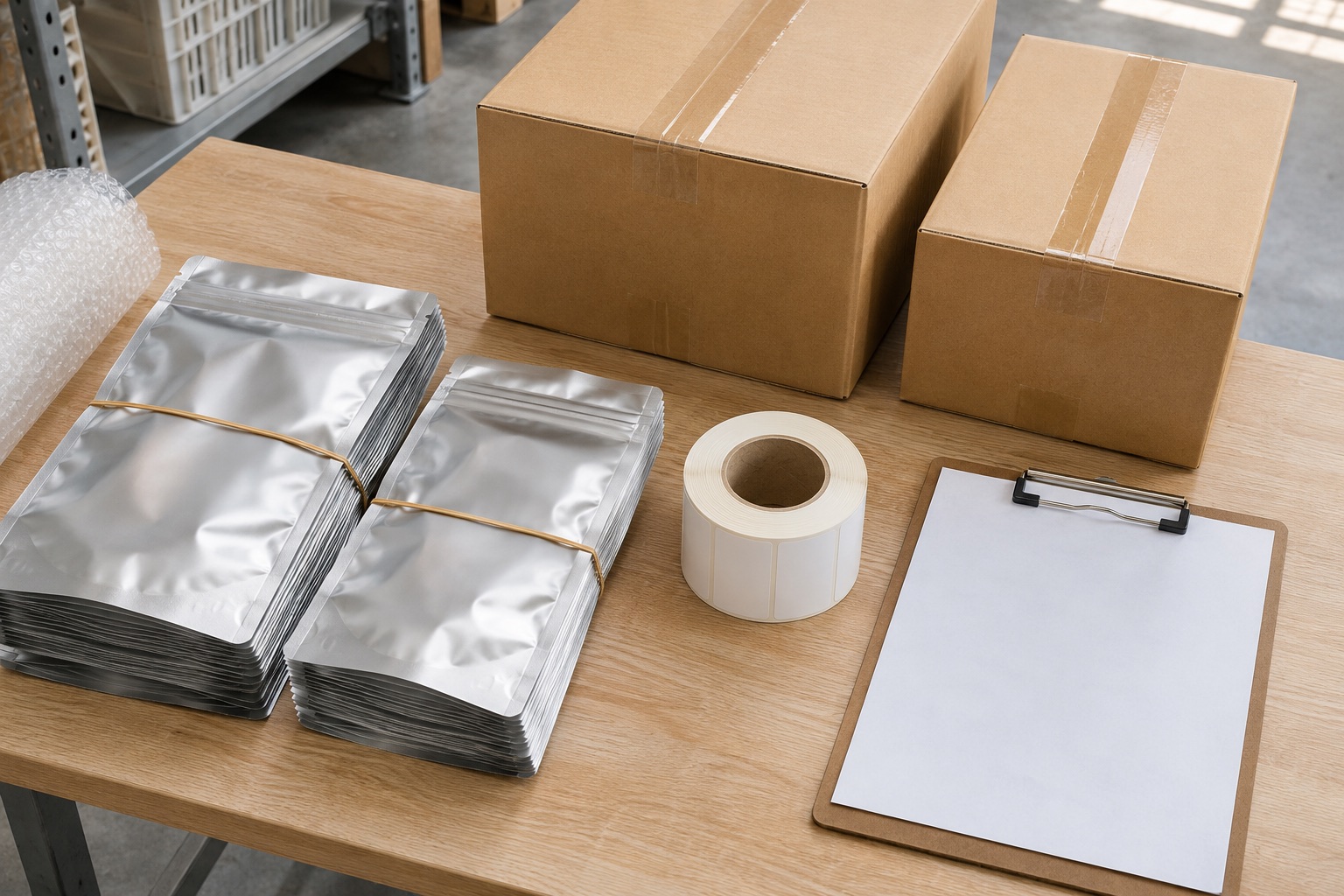
- No dispatch notice, so the delivery cannot be matched to an order.
- Exactly the calculated weight and not a gram more, so the bag count falls short.
- Gross weight on the carton and no net weight, so the receiving check cannot be completed.
- No lot marking, so nothing afterwards can tie the order back to what arrived.
- Material shipped before the order is confirmed, which does not start the lead time and does take up space.
- Assuming we will handle the import. We will not, and nothing moves until the entry is made in your name or your agent’s.
- Printed bags shipped without the specification checked first.
None of these are exotic. Every one of them is a question that takes a sentence to ask before the freight is booked, which is why it is worth asking.
Our lead time, minimums and the full rate card are on the contract packing page.
Questions we get asked
Can you be the importer of record?
No, and we cannot act as your Customs Procedure Agent either. The entry is made in your name, or in the name of an agent you have appointed and filed with Japanese customs. Our part starts when the material is physically at our line in Kyoto.
My company has no address in Japan. What do I need?
Japan Customs requires a person living abroad to designate a Customs Procedure Agent in Japan and notify it in advance on Customs Form C No. 7500. Separately, a licensed customs broker files the declaration. One firm covers both roles only if it holds a brokerage licence.
Is there anything else before the goods can clear?
For food, yes. Article 27 of the Food Sanitation Act obliges the importer to notify the Minister of Health, Labour and Welfare on each occasion, filed with the quarantine station rather than with customs, before clearance is finished. Notifications are accepted from seven days before arrival.
What happens if material arrives with no notice?
It carries a USD 85 charge per case, and it is the easiest charge on our list to avoid. Send us the dispatch date, the carrier and the tracking number when the material ships.
Can you handle chilled or frozen material?
No. We hold and fill dry goods at room temperature, with no refrigerated or frozen handling at any point.
Related reading
- A first packing order, step by step with the dates
- Where our part ends, and the leg after it
- The three weeks when nothing ships in Japan
- Packed in Japan or product of Japan
- How Japanese suppliers quote and get paid
- Matcha packing, priced out at three bag sizes
Tell us what is shipping and when it lands. We will confirm it before you book the freight. WhatsApp reaches us fastest, and we answer in English. If you would rather not use it, the enquiry form does the same job.
Message us on WhatsApp Use the enquiry form Agriture Inc., Kyoto, Japanこの記事を書いた人
関連記事
-
 Organic, Halal, Vegan: the Claims We Cannot Certify
-
What Goes on the Label, and Who Supplies It
-
Boxed Sets and Multi Packs: the Count That Decides Everything
-
Private Label Matcha: Who Sells You the Tea, and Who Bags It
-
Hojicha Is the Easy One to Bag, and the Roast Is Why
-
Tea Filter Bags in Small Quantities, and the Arithmetic Nobody Expects
-
Pack It in Japan, or Ship It Home in Bulk and Pack It There
-
Dried Shiitake: the One Where the Customer Wants to See It