Our Stock Bags, and What Each One Costs Per Piece

The bag is usually a bigger decision than brands expect, and on a first order it is often the largest line on the invoice. It affects your shelf life, it is most of what the customer sees, and it is the one component you cannot change after the run without doing the run again.
We hold 25 bag types in stock, from USD 0.10 to USD 1.85 a piece. The ones below are the ones most projects end up choosing from; the full list is on the landing page. This is how it breaks down, what each material is actually for, and the arithmetic that should drive the choice.
目次
First, how much the bag decides
Filling is USD 0.65 a bag whatever you put it in. The bag itself swings by a factor of more than eighteen across our range, so it moves your cost per unit more than anything else on the order. Same 500 bag run, same single label, three different stock bags:
| Bag chosen | Per piece | 500 bags of material | Packing cost per bag |
|---|---|---|---|
| Plain sweets pack, 100 by 120 mm | USD 0.10 | USD 50 | USD 1.17 |
| Clear stand up with window, 120 by 200 mm | USD 0.45 | USD 225 | USD 1.52 |
| Aluminium Lamizip, 340 by 240 plus 70 mm | USD 1.85 | USD 925 | USD 2.92 |
Each of those includes the USD 0.65 fill, the USD 0.15 label, the one time USD 130 set up spread over 500 units and the USD 2.55 dispatch. The only thing that moved was the bag. So the question is not which bag is nicest. It is which bag your product actually needs, because the gap pays for a lot of other things.
Aluminium, when light is the enemy
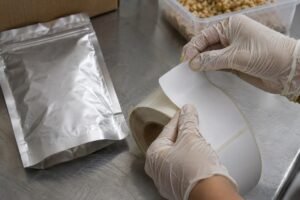
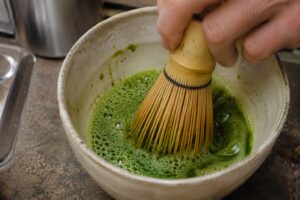
Matcha, yuzu powder and anything else whose colour is the product belongs in a foil barrier. Light and oxygen are what turn bright green matcha into something dull and flat. A clear window pouch looks better in a product photograph than it does on a lit shelf some months later.
| Item | Size | Price per piece |
|---|---|---|
| Aluminium stand up pouch with zipper, silver | 130 by 130 mm | USD 0.30 |
| Aluminium Lamizip | 340 by 240 plus 70 mm | USD 1.85 |
| Biomass metallised kraft stand pouch with zipper | 180 by 240 mm | USD 0.60 |
| Biomass metallised kraft three side seal pouch | 110 by 125 mm | USD 0.20 |
The small aluminium stand up pouch at USD 0.30 is the workhorse for retail tea and powder. It is the bag in the worked example in our matcha article, and for a 20 g to 40 g retail format it is hard to beat on cost for the protection it gives.
The Lamizip at the other end of the list is a large bag, and at USD 1.85 it is the most expensive thing we stock. It earns that on wholesale and refill sizes where one bag replaces ten, not on a retail shelf.
Metallised kraft, if silver is wrong for the brand
The two biomass metallised kraft options are worth a look if you want a barrier without the silver technical look. They carry a metallised layer behind a paper face, so they are a barrier bag that photographs like craft packaging. The three side seal at USD 0.20 is the cheapest barrier bag on our list, which makes it a good sample or single serve format for a product that cannot sit in clear film.
Clear film, when the product sells itself
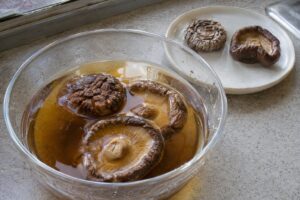
Dried vegetables, dried fruit and cut herbs are the opposite case. Nobody distrusts a dried shiitake because they can see it, and the look of the contents is doing your marketing for you. These are also the cheapest bags we hold.
| Item | Size | Price per piece |
|---|---|---|
| Plain sweets pack, semi clear matte | 100 by 120 mm | USD 0.10 |
| Clear flat pouch | 120 by 140 mm | USD 0.15 |
| Clear flat pouch with zipper, light goods | 140 by 230 mm | USD 0.30 |
| Clear stand up pouch with zipper, white, window | 120 by 200 mm | USD 0.45 |
| Clear stand up pouch with zipper, white, window | 140 by 220 mm | USD 0.50 |
Flat or stand up
A flat pouch costs roughly twenty to thirty cents less a piece, and the money buys shelf presence. A flat pouch is right for a refill, a sample or anything sold in a box. A stand up pouch is right when the bag has to hold its own on a shelf next to competitors, and the zipper matters when the customer will open it more than once.
On a 500 bag run that difference is a hundred to a hundred and fifty dollars in total. It is worth deciding on the shelf, not on the spreadsheet.
Worth being concrete about what the money buys, because the gap is wider than people expect once a window or a zipper is involved.
| Code | Format | Size | Per piece | Across 500 |
|---|---|---|---|---|
| PKG-017 | Clear flat pouch, no zipper | 120 by 140 mm | USD 0.15 | USD 75 |
| PKG-007 | Clear flat pouch with zipper | 140 by 230 mm | USD 0.30 | USD 150 |
| PKG-004 | Semi clear stand up pouch with zipper | 110 by 170 mm | USD 0.35 | USD 175 |
| PKG-001 | Clear stand up pouch with zipper, window | 120 by 200 mm | USD 0.45 | USD 225 |
| PKG-003 | Clear stand up pouch with zipper, window | 140 by 220 mm | USD 0.50 | USD 250 |
Three hundred and fifty dollars separates the cheapest from the dearest across a 500 bag run, against a fill cost of USD 325 that does not move. On a first order the bag is frequently the largest single line on the quotation, which is why it is worth five minutes rather than thirty seconds.
When a flat pouch is actually the better product
Flat gets treated as the budget option, and for a product that has to stand on a shelf it usually is. There are three cases where it is the right answer on its own merits, not as a compromise.
- A refill. The customer already owns the jar or the tin, and a bag that stands up is paying for presence nobody will see.
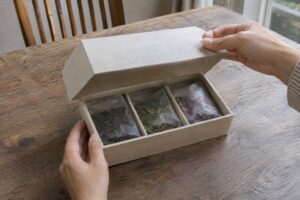
- Anything sold inside a box or a set. The outer does the standing, and a stand up pouch inside it wastes both money and space in the box.
- A product sold online rather than from a shelf. The photograph does the work that a gusset would do in a shop, and a flat pouch ships in a smaller carton.
That last point is worth more than it looks at volume. Flat pouches pack denser, so a carton holds more of them, which shows up in the freight out of Japan rather than in our invoice. The comparison with packing near your own market has more on why freight on finished goods is the cost that grows fastest.
The zipper is a separate decision from the shape
Flat or stand up is about presence. A zipper is about how the product gets used, and the two questions get conflated because most stand up pouches on our list come with one.
Ask it plainly: will the customer open this more than once. A single use sachet does not need a zipper at any price. A 100 g bag of tea or dried mushroom will be opened dozens of times, and we fill in ambient air with no nitrogen flushing and no vacuum, so a resealable top is the only thing keeping the rest of the product in reasonable shape after the first opening.
What the bag does not decide on its own
Everything above is about what the bag protects the product from and what it looks like doing it. It is not a shelf life answer. How long your product keeps depends on the material itself, its moisture, how it was dried and milled, and how it is stored and shipped after it leaves us, and we fill in ambient air with no nitrogen flushing and no vacuum on any format. So treat the bag as one input. If you need a shelf life figure you can print, that comes from testing the finished product, which is work for an accredited laboratory. A packing line cannot give you that number.
Tea filters and bulk
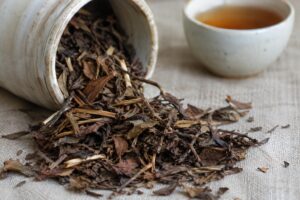
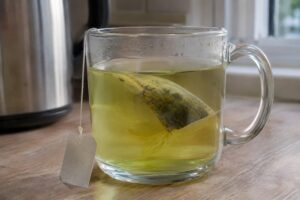
For loose leaf going into individual brewing bags we stock a tagged mesh filter at 65 by 80 mm for USD 0.25 a piece. The tag is the part that is hard to source in small quantities elsewhere, and it is the format worth having once you have tried selling only loose leaf.
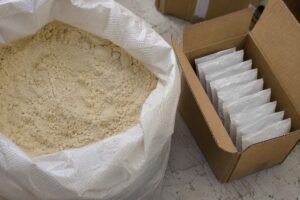
For bulk and wholesale, plain polyethylene bags in several sizes run from USD 0.25. These are the right answer for anything going to a cafe, a distributor or your own repacking operation, where the bag is a container and nobody sees it.
What no bag on this list can fix
Two limits are worth stating plainly, because no material choice gets around them.
- Stick packs and sachet sticks. The long thin stick is the one format our line genuinely cannot run, and it is a common ask for single serve matcha and kinako. Ask about any other shape before you assume it is ruled out.
- Gas flushing and vacuum. Bags are filled and heat sealed in ambient air on every format. If your shelf life calculation depends on a nitrogen headspace, an aluminium bag narrows the gap but does not close it.
When to supply your own bags
Printed artwork is the honest answer. Our stock is unprinted, so if you want your brand on the bag itself instead of on a label applied over it, you bring the bags. There is a flat USD 45 handling charge on the order when you do, which covers receiving, checking and staging them.
That charge is small enough that it is rarely the deciding factor. At 500 bags it is nine cents a unit, at 5,000 it is under one cent. What matters far more is getting the specification to us before you ship, because a bag that will not feed through the sealer is discovered on the day otherwise, with your material already in Kyoto and the run scheduled. Send the material code, the dimensions and the seal specification, and we will confirm it runs before anything moves.
If you want a bag we do not stock but you do not want to buy a print run, we can also source it to your specification and quote it per order. The stock list is a starting point. Ask before you design around it.
Label positions are priced separately
Labels are USD 0.15 per position, and a back label counts as its own position. A front label plus an ingredients panel on the back is therefore USD 0.30 a bag, or USD 150 across a 500 bag run. For a lot of overseas brands this is the cheaper route to a finished looking product than printing bags, at least until the volumes justify the print.
Check that the label actually fits the bag before you design it. A 130 by 130 mm pouch has a usable front panel well under that, once the seal and the gusset are taken out, and a label drawn to the full dimension will wrap round the edge. The three side seal sachets are tighter again. Send us the bag you have chosen and the label size you want, and we will tell you whether the panel takes it before the print goes ahead.
The complete stock list, all 25 items
Everything above is the shortlist by use. This is the whole thing, with the internal codes, because sooner or later you will want to quote one at us. Prices are per piece and they do not change with the quantity you order.
| Code | Item | Size | Per piece |
|---|---|---|---|
| PKG-012 | Aluminium stand up pouch with zipper, silver | 130 by 130 mm | USD 0.30 |
| PKG-026 | Aluminium Lamizip pouch | 340 by 240 plus 70 mm | USD 1.85 |
| PKG-001 | Clear stand up pouch with zipper, white, window | 120 by 200 mm | USD 0.45 |
| PKG-003 | Clear stand up pouch with zipper, white, window | 140 by 220 mm | USD 0.50 |
| PKG-004 | Semi clear stand up pouch with zipper | 110 by 170 mm | USD 0.35 |
| PKG-010 | Biomass metallised kraft stand pouch with zipper | 180 by 240 mm | USD 0.60 |
| PKG-011 | Biomass metallised woodfree stand pouch with zipper | 180 by 240 mm | USD 0.60 |
| PKG-009 | Biomass kraft pouch with zipper, clear front | 120 by 150 mm | USD 0.40 |
| PKG-029 | Biomass metallised kraft three side seal pouch | 110 by 125 mm | USD 0.20 |
| PKG-030 | Clear kraft pouch with zipper | 120 by 200 mm | USD 0.45 |
| PKG-032 | Lamizip, unryu pattern | 32 plus 160 by 120 mm | USD 0.45 |
| PKG-007 | Clear flat pouch with zipper, light goods | 140 by 230 mm | USD 0.30 |
| PKG-006 | Clear flat pouch with zipper, light goods | 160 by 230 mm | USD 0.35 |
| PKG-008 | Clear flat pouch with zipper, light goods | 170 by 260 mm | USD 0.35 |
| PKG-034 | Clear flat pouch with zipper, top load | 160 by 150 mm | USD 0.35 |
| PKG-033 | Clear flat pouch with zipper, top load | 160 by 230 mm | USD 0.40 |
| PKG-015 | Clear flat pouch | 100 by 120 mm | USD 0.15 |
| PKG-017 | Clear flat pouch | 120 by 140 mm | USD 0.15 |
| PKG-016 | Plain sweets pack, clear | 100 by 135 mm | USD 0.10 |
| PKG-018 | Plain sweets pack, semi clear matte | 100 by 120 mm | USD 0.10 |
| PKG-014 | Tagged mesh tea filter | 65 by 80 mm | USD 0.25 |
| PKG-013 | Nylon with polyethylene bag | 380 by 530 mm | USD 0.85 |
| PKG-031 | Zipper polyethylene bag, 0.08 mm | 240 by 340 mm | USD 0.25 |
| PKG-027 | Zipper polyethylene bag | 340 by 480 mm | USD 0.35 |
| PKG-028 | Clear polyethylene sack, 45 L, 0.08 mm | Sack | USD 0.50 |
How to read the list
Three groups, and it helps to see them that way. Codes PKG-001 through PKG-012 are retail pouches, the ones that face a customer. PKG-013 and PKG-027 through PKG-031 are bulk sacks for wholesale, where nobody sees the bag. PKG-014 is the tea filter, which is its own thing entirely, and it has an article of its own because the counting works differently.
The price range across the whole list runs from USD 0.10 to USD 1.85, which is a spread of almost twenty times. On a 500 bag order that is the difference across USD 50 of packaging at one end, USD 925 at the other, against a fill cost of USD 325 that does not move. On most first orders the bag, not the filling, is the number worth agonising over.
A rough rule
- Colour sensitive powder, matcha and yuzu: aluminium or metallised kraft.
- Visually appealing dried pieces: clear film, stand up if it faces a shelf.
- Samples and refills: flat pouches, the cheapest lines on the list.
- Loose leaf for brewing: the tagged mesh filter at USD 0.25.
- Wholesale and cafe: plain polyethylene from USD 0.25.
- Your own artwork: bring the bags, pay the USD 45, send the spec first.
Full packaging list with all 25 stock items is on our contract packing page.
Questions we get asked
Can I supply my own printed bags?
Yes. There is a flat USD 45 handling charge per order when you do, covering receiving, checking and staging them. Send us the material code, the dimensions and the seal specification before you ship, so we can confirm the bag feeds through the sealer.
Do you stock a bag that is not on the list?
The 25 items are what we hold. We can also source a bag to your specification and quote it per order, so ask before you design around the list.
How many label positions can a bag take?
As many as you want to pay for. Each position is USD 0.15, and a back label counts as its own position, so a front plus an information panel is USD 0.30 a bag.
Which bag is right for a powder that must not fade?
An opaque one. The aluminium stand up pouch at USD 0.30 is the default, and the biomass metallised kraft options give you a barrier with a paper face. We fill in ambient air with no gas flushing, so the bag is the only protection we add.
Can you put the product in a box or a tin?
Our stock list covers bags. If your product needs an outer, raise it in your first message so we can tell you what is possible on your order.
Related reading
- Tea filter bags in small quantities
- What a 500 bag minimum really means
- Matcha packing, priced out at three bag sizes
- Kinako in retail bags
- What goes on the label, and who supplies it
- Boxed sets and multi packs
- Packed in Japan or product of Japan
Send us the bag size and the quantity. That is enough to price it. WhatsApp reaches us fastest, and we answer in English. If you would rather not use it, the enquiry form does the same job.
Message us on WhatsApp Use the enquiry form Agriture Inc., Kyoto, Japan- Getting Matcha Packed in Japan: the Numbers That Decide It
- How Japanese Suppliers Quote, Decide and Get Paid
この記事を書いた人
関連記事
-
 Organic, Halal, Vegan: the Claims We Cannot Certify
-
What Goes on the Label, and Who Supplies It
-
Boxed Sets and Multi Packs: the Count That Decides Everything
-
Private Label Matcha: Who Sells You the Tea, and Who Bags It
-
Hojicha Is the Easy One to Bag, and the Roast Is Why
-
Tea Filter Bags in Small Quantities, and the Arithmetic Nobody Expects
-
Pack It in Japan, or Ship It Home in Bulk and Pack It There
-
Dried Shiitake: the One Where the Customer Wants to See It