Rice Flour Is Dense, Which Makes It the Cheap One to Bag

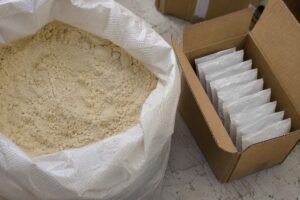
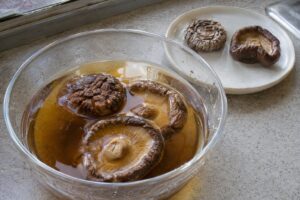
Most of what comes through our line is light for its volume. Kinako is. Roasted tea leaf is. Dried mushroom is, dramatically. Rice flour is the exception, and it is the only material we handle where people are surprised in the pleasant direction.
A 200 g bag of rice flour is a smaller object than a 200 g bag of almost anything else we fill. That has consequences for the bag you choose, the price you pay and the amount of material a first order ties up.
目次
Dense material, smaller bag, lower bag cost
Bag price on our list tracks size more than anything else, so a material that needs less volume per gram lands further down the price column. Compare the same 100 g fill across three materials we actually handle.
| Material | How it behaves | Bag you would reach for |
|---|---|---|
| Rice flour | Dense, settles readily | A small pouch. PKG-017, USD 0.15 |
| Kinako | Light, takes up room | A larger pouch, often two sizes up |
| Dried shiitake slices | Mostly air | Larger again. Volume decides it |
The practical saving is real but modest, and it is worth keeping in proportion: the fill rate of USD 0.65 a bag does not change with the material, so the bag is the only line that moves. The complete stock list has the sizes against the prices if you want to work it through for your own fill weight.
The flip side is the material commitment
Dense works against you in one place: the kilograms you have to buy. Our minimum is 500 filled bags, and at a retail size that suits a dense flour, that is a lot of flour.
| Fill weight | Net flour for 500 bags | What it suits |
|---|---|---|
| 100 g | 50 kg | Small retail, a baking trial size |
| 200 g | 100 kg | The common retail format |
| 500 g | 250 kg | Home baking, repeat buyers |
| 1 kg | 500 kg | Food service, wholesale |
Five hundred bags of 200 g is a hundred kilograms of rice flour. That is the number to take to your producer before you take anything to us, and it is why the retail size is the first decision rather than the last. A 100 g trial format halves the commitment and is a perfectly normal way to start.
Those are net weights. Filling to a target weight leaves a little in the machine and in the last part filled bag, so send a margin on top and tell us the shipping weight with the bag count so we can confirm it.
Not all Japanese rice flour is the same product
Japan has several distinct rice flours with established names, made from different rice and milled differently, and they are not interchangeable in a recipe. Your producer knows exactly which one they are selling you. Your customer, if they bake, will also know. The risk sits in the middle, with a brand that buys one and labels it as another.
We cannot tell them apart by looking, and it is not our place to. What we can do is put on the bag whatever your producer confirms in writing, so get the name from them on a specification rather than from a supplier listing or a translation.
The practical ask is short: get the product name as your producer writes it, get what it is made from, and get the intended use. Those three lines travel all the way through to your label, and they are much harder to establish after the material is already in Kyoto.
How it runs on a filling line
Generally well, which is not something we can say about every powder. A dense flour that settles is easier to weigh accurately than a light one that floats, and rice flour sits at the comfortable end of that range.
Two things still vary by producer and are worth telling us. How finely it is milled, because a very fine grind behaves more like matcha, slower and prone to packing down. And whether it has shown any tendency to clump in storage, which matters more for a flour than for a leaf. Where there is a real question about how a material feeds, we will say we need it in hand to answer rather than guessing on the day.
Pairing it with a second product
Rice flour on its own is an ingredient rather than a brand, and most of the projects we see pair it with something. The 500 is a total across the order, so that pairing costs nothing extra in minimum terms.
Two patterns come up. One is two sizes of the same flour, a 200 g retail bag plus a 1 kg bag for people who bake often, which is one material and two bag lines. The other is rice flour plus a Japanese flavouring that goes into the same baking: kinako and matcha are the two we see most. That is two materials in one order, each filled separately at USD 0.65 a bag.
Either way it is one set up fee, one shipment and one dispatch handling charge. Kinako is worth reading alongside this one if you are considering that pairing, because the two flours behave as opposites on a filling line and the bag decisions run in different directions.
The gluten free question is not ours
Rice flour is the ingredient people most often want to make a claim about, and it is the claim we are least able to help with. Whether your product may be labelled gluten free in the market you sell in depends on that market’s threshold, on your producer’s own handling, and on testing we do not run.
What we can tell you is what happens on our side: we weigh a finished material into a bag and seal it. We do not run laboratory analysis of any kind, so no testing, no thresholds, no certificates. Those come from an accredited laboratory through your producer. Packed in Japan or product of Japan covers the same split for origin claims, which works the same way.
Settle the claim with your broker while the artwork is still a draft, and put it on a label rather than into printed film until the wording has survived a season. Labels are USD 0.15 per position and can be reprinted. Printed bags cannot.
A worked first order
Five hundred retail bags of 200 g, a clear flat pouch with a zipper, one front label, one hundred kilograms of flour from your producer.
| Line | Unit | 500 bags |
|---|---|---|
| Fill & seal | USD 0.65 per bag | USD 325.00 |
| Clear flat pouch with zipper, 140 by 230 mm | USD 0.30 per piece | USD 150.00 |
| Label application, one position | USD 0.15 per position | USD 75.00 |
| Set up fee, first order only | USD 130 once | USD 130.00 |
| Dispatch handling | USD 2.55 per shipment | USD 2.55 |
| Total, first order | USD 682.55 | |
| Per bag, first order | USD 1.37 | |
| Per bag, repeat orders | USD 1.11 |
Under a dollar fifty a bag of packing against a 200 g retail product is a comfortable ratio, and it is the reason rice flour is a sensible first project for a brand that has not imported from Japan before.
What to tell us when you ask
- How finely it is milled, as a number if your producer has one.
- The fill weight per bag and the total bag count.
- Whether it is plain rice flour or already blended with anything.
- Whether you want a stock bag or are supplying printed bags yourself.
- The date you need finished stock in your own warehouse.
Rates, minimums and conditions are on the contract packing page.
Questions we get asked
Can you mill the rice for me?
No. Milling belongs to your producer. The flour reaches our line finished and ready to weigh.
Why is 500 bags so much flour?
Because rice flour is dense and the retail sizes are large. Five hundred bags of 200 g is a hundred kilograms net. A 100 g trial format halves it.
Can you label it gluten free?
We apply whatever label you supply, at USD 0.15 per position. Whether the claim is permitted is for your broker or the regulator in your market, and any testing behind it comes from an accredited laboratory through your producer.
Is a clear bag right for flour?
Usually yes. Rice flour has no colour to lose, so the reasons to pay for an opaque barrier bag are weaker than they are for matcha. A zipper matters more, because a baking ingredient gets opened repeatedly.
Can you blend rice flour with other flours?
Only as a measured mix. Send both components finished with the grams of each and we weigh them into one bag at USD 1.10 instead of USD 0.65. We do not work out ratios or develop blends.
Related reading
- Dried shiitake, where volume decides the bag
- Kinako in retail bags
- Stock bags and what each one costs per piece
- Packed in Japan or product of Japan
Tell us the grind, the fill weight and the bag count. That is enough to price a run. WhatsApp reaches us fastest, and we answer in English. If you would rather not use it, the enquiry form does the same job.
Message us on WhatsApp Use the enquiry form Agriture Inc., Kyoto, Japan- Dried Shiitake: the One Where the Customer Wants to See It
- Sakura: the Form It Arrives In Decides Whether We Can Run It at All
この記事を書いた人
関連記事
-
 Organic, Halal, Vegan: the Claims We Cannot Certify
-
What Goes on the Label, and Who Supplies It
-
Boxed Sets and Multi Packs: the Count That Decides Everything
-
Private Label Matcha: Who Sells You the Tea, and Who Bags It
-
Hojicha Is the Easy One to Bag, and the Roast Is Why
-
Tea Filter Bags in Small Quantities, and the Arithmetic Nobody Expects
-
Pack It in Japan, or Ship It Home in Bulk and Pack It There
-
Dried Shiitake: the One Where the Customer Wants to See It