Packed in Japan or Product of Japan: Two Different Claims

This question comes up early, usually phrased as whether the brand can put Made in Japan on the bag. It is a fair question with an uncomfortable answer, which is that it is two questions wearing one coat, and a packing line can only answer one of them.
What follows separates the part a packing line knows from the part that belongs to your customs broker and to the rules of the market you are selling in. The second part is not us being evasive. Origin rules differ by country, by product and by the claim you want to make, and a supplier in Kyoto guessing at the rules in your market would be doing you real harm.
目次
Two facts that are often two different countries
Any packed product has at least two origins in it, and brands routinely collapse them into one sentence.
| What it describes | Who knows the answer | |
|---|---|---|
| Where the product was produced | Where the tea was grown, the fruit was dried, the beans were roasted | Your producer |
| Where the product was packed | Where it was weighed into retail bags, sealed, labelled | Us, for the runs we do |
| What your label may claim | The wording permitted in the market where it is sold | Your customs broker / the regulator in that market |
When the material is Japanese and the packing is Japanese, those first two rows agree and the conversation is short. The interesting case is the other one: a powder grown and milled outside Japan, shipped in, bagged in Kyoto. The packing is genuinely Japanese. The product is not, and no amount of careful wording changes where the crop grew.
Do not assume bagging changes origin
This is the part worth being blunt about. In many origin regimes, repacking on its own is not treated as the kind of processing that changes a product’s origin. A brand that ships a powder into Japan, has it bagged and then describes the result as a product of Japan may be making a claim it cannot support.
Whether that is true for your product, in your market, is a question for your broker. We raise it because the brands who get into trouble are the ones who never asked, not the ones who asked and got a complicated answer.
What a packing line does not issue
We do not produce product documentation about the goods themselves. No microbiological results, no nutritional panels, no shelf life studies, because we do not run laboratory analysis of any kind. Those come from your producer or from an accredited laboratory, and they are usually the longest lead item in a launch, so start them early and do not let the packing schedule set your expectations for them. The full boundary is in what a packer will not do.
A certificate of origin is a separate document again, and there is more than one kind of it. Which one your shipment needs depends on what you are claiming.
- The ordinary certificate of origin is issued to the exporter through a chamber of commerce. It states a country of origin for general purposes. It does not by itself get you a tariff rate under a trade agreement.
- A preferential claim under a trade agreement works differently, and differently again depending on the agreement. Some use a certificate issued by a designated body. Others, including the Japan to EU agreement, the CPTPP and the Japan to UK agreement, are claimed on a declaration completed by the exporter, the producer or the importer, with no chamber certificate in the process at all.
For a European buyer in particular that distinction is worth knowing before anybody asks a chamber of commerce for the wrong document. Which route applies to your shipment is a question for your forwarder or your broker, and the requirements sit in the text of the agreement that covers your destination. None of these documents is issued by a packing line.
The Japanese side of the paperwork
Two things about Japan specifically are worth knowing even if you never sell a bag there.
The first is that Japanese food labelling practice identifies who processed the product, which for a packing run means the company that did the bagging. If any part of your production is sold inside Japan, that convention is likely to matter to you, and it is worth confirming properly, and do not assume your export label will do. If everything you make with us leaves the country, the Japanese domestic label rules are not your concern, but the question of who is named as processor may still come up in your own market.
The second is that we are not the importer of record for your incoming material. The entry into Japan is made in your name, or in the name of an agent you have appointed and filed with Japanese customs, which means the import documents carry your name. That is occasionally useful, because it is your paper trail from the start. Sending your material to a Japanese packer covers how that leg works.
What this means for the bag itself
The practical upshot is that the honest claim is usually narrower and more specific than the one brands reach for first, and it usually sells just as well.
- Material produced in Japan, packed by us in Japan: the strongest position, and the one where your producer’s own documentation does most of the work.
- Material produced elsewhere, packed by us in Japan: the packing is a fact you can state. Say what is true about it. Do not imply more.
- Either case: the specific is more persuasive than the general. Naming the prefecture a tea came from does more for a customer than the words Made in Japan on their own.
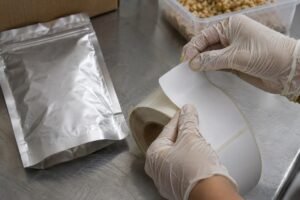
Labels are applied at USD 0.15 per position, and a back label counts as its own position, so adding a proper information panel to a bag costs USD 0.15 a unit. That is a small price for getting the wording right, and it is cheaper than printing claims onto a bag you then cannot use. The stock bag list has the material options.
What a label can say that is simply true
Most of the useful wording is factual, and it does not need a ruling from anybody. The bag can name the prefecture the material came from. It can name the producer. It can say the product was bagged in Kyoto, Japan, because that is what happened. It can give the month it was packed. None of those is an origin claim, and all of them are more specific than Made in Japan.
What needs checking is anything that compresses the whole supply chain into one phrase. Product of Japan, Japanese matcha where the tea is not Japanese, or a flag beside the brand name. Those are claims, they are governed where you sell, and they are the ones a customs officer or a retailer will question.
One practical note for a brand based overseas: the entry into Japan is yours to arrange, and if your company has no address in Japan it starts with designating a Customs Procedure Agent and notifying Japan Customs in advance. Sending your material to a Japanese packer has that step and the Food Sanitation Act notification that goes with it.
Claim by claim, who has to confirm it
The useful way to hold this is as a list of sentences you might want on a bag, with the person who can actually sign off on each one.
| What the bag says | Is it a packing fact | Who confirms it |
|---|---|---|
| Packed in Japan | Yes. We did it | Us, for the facts of the run |
| Bagged in Kyoto, Japan | Yes | Us |
| Product of Japan | No. It is an origin claim | Your broker / your regulator |
| Made in Japan | No. Same claim, looser wording | Your broker |
| Japanese matcha, tea grown in Uji | No. It is about the material | Your producer |
| Grown in Kagoshima | No | Your producer, with documentation |
| Organic | No. It is a certification claim | The certifying body |
| A Japanese flag on the front | No. It reads as origin | Your broker |
Only the first two rows are ours, and that is the whole shape of this article in one table. Everything else on a bag is somebody else’s to confirm, and the expensive mistake is assuming the packer is the one who knows.
When to finalise the artwork
The expensive version of this mistake is not a wrong claim on a bag. It is a wrong claim on five thousand printed bags. Printed film is bought in a run, it cannot be amended, and it is usually ordered weeks before anybody has asked a broker what the label may say.
So invert the usual order. Settle the origin question with your broker while the artwork is still a draft. Then decide whether the information goes on a label or into the print. On a first order of 500 to a few thousand bags a stock bag plus a label is almost always the cheaper route, and the real advantage is that a label can be reprinted for the next run when the wording turns out to need a change.
Commit to printed film once the wording has survived a season and a market, not before. The saving per bag is real at volume, and it is not worth having at the point where you are still finding out what you are allowed to say.
The same logic applies to anything you are unsure about, not only origin. A nutrition panel, an allergen statement, a storage instruction: if the answer is still open, put it on a label for the first run and into the print later. Nobody has ever regretted that order. The reverse costs a print run.
Who to ask, in order
- Your producer, for where the material was grown and produced, and for the documentation that proves it.
- Your customs broker or the regulator in your market, for what your label may claim and what has to appear on it.
- Us, for how the packing itself works and which formats we can run.
- Your forwarder, for shipping documents including a certificate of origin if your buyer requires one.
Four questions, four different people, and only one of them is the packer. The projects that go smoothly are the ones where the brand asked all four before the artwork was finalised, while the wording could still change.
Our scope, lead time and rate card are on the contract packing page.
Questions we get asked
Can I write Made in Japan on the bag?
That is a question for your customs broker or the regulator in the market you sell in, not for a packing line. What we can confirm is the packing: filling, sealing and labelling happened at our facility in Kyoto.
Does bagging in Japan change the origin of the product?
In many origin regimes repacking on its own is not treated as the kind of processing that changes origin. Whether that applies to your product in your market is for your broker to answer.
Can you issue a certificate of origin?
No. The ordinary certificate is issued to the exporter through a chamber of commerce. A preferential claim under a trade agreement works differently again, and under agreements such as the Japan to EU one it rests on a declaration by the exporter, producer or importer.
What can go on a label that is simply true?
The prefecture the material came from, the producer’s name, the fact that it was bagged in Kyoto, the month it was packed. None of those is an origin claim and all of them are more specific than Made in Japan.
Should I print the claim on the bag or use a label?
A label, on a first order. Labels are USD 0.15 per position and they can be reprinted for the next run. Printed film cannot be amended, and it is usually ordered weeks before anybody has asked a broker what the label may say.
Related reading
- Sending your material to a Japanese packer
- A packer is not a manufacturer
- Kinako in retail bags
- How Japanese suppliers quote and get paid
Tell us the bag size and the quantity. We will tell you what the packing side covers. WhatsApp reaches us fastest, and we answer in English. If you would rather not use it, the enquiry form does the same job.
Message us on WhatsApp Use the enquiry form Agriture Inc., Kyoto, Japan- Kinako in Retail Bags: What an Overseas Brand Decides First
- Private Label Matcha: Who Sells You the Tea, and Who Bags It
この記事を書いた人
関連記事
-
 Organic, Halal, Vegan: the Claims We Cannot Certify
-
What Goes on the Label, and Who Supplies It
-
Boxed Sets and Multi Packs: the Count That Decides Everything
-
Private Label Matcha: Who Sells You the Tea, and Who Bags It
-
Hojicha Is the Easy One to Bag, and the Roast Is Why
-
Tea Filter Bags in Small Quantities, and the Arithmetic Nobody Expects
-
Pack It in Japan, or Ship It Home in Bulk and Pack It There
-
Dried Shiitake: the One Where the Customer Wants to See It