Where Our Part Ends: the Handover in Kyoto and the Leg After It

Most of what gets written about contract packing stops at the moment the bags are sealed. The part that actually delays shipments is what happens in the three days after that, and it is the part nobody has arranged.
Our scope ends with finished cartons, ready, inside Japan. Everything past that point is yours. Here is what yours means in practice, and what to have set up before the run finishes instead of after.
目次
What we do at the end of a run
- Fill, seal and label to your specification.
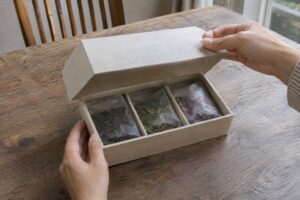
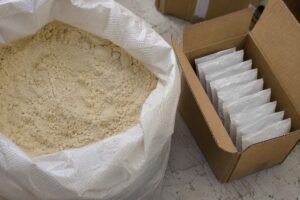
- Pack the finished bags into shipping cartons.
- Mark the cartons so your forwarder can identify them.
- Tell you they are ready, with the carton count plus the weights.
- Hand them to the carrier or the forwarder you nominate, in Japan.
Dispatch handling is USD 2.55 per shipment. That covers staging the cartons and handing them over. It is not freight, and freight is never included in what we quote.
What we do not do
We do not book international freight. We do not act as exporter of record, we do not raise export documentation in our name, and we do not arrange insurance on a shipment we are not party to.
This is the same boundary that applies on the way in, where you are the importer, not us. The symmetry is deliberate. We are a packing line in Kyoto, and a company that handles your customs on both ends is a different kind of business with a different kind of licence.
What to have in place before the run finishes
Four things, and the order matters because two of them take longer than people expect.
A forwarder who already knows about you
Not a quote. A relationship, with an account open and your details on file. A forwarder meeting you for the first time on the day your cartons are ready will take days to do what an existing account does in hours.
Set this up while the run is still in progress. It costs nothing to have a forwarder ready, and it is the single most common reason finished stock sits in Kyoto longer than it needed to.
An agreed term for the handover
Be explicit about where risk and cost pass to you. Our side of it is simple: we release finished cartons in Japan to the party you nominate. Whatever Incoterm you put on your paperwork, it has to be one where you take the goods in Japan, because that is the only thing we can actually do.
Tell your forwarder and your insurer that in those words before the run ends. The version to avoid is discovering on the day that somebody assumed we were shipping it to them.
Somewhere for the cartons to go
We are not a warehouse. Finished goods sitting at a packing line are occupying space that the next order needs, so plan for collection promptly rather than treating Kyoto as storage. If your freight is weeks away, say so early so we can tell you what is workable.
If something slips on your side, tell us as soon as you know rather than on the day. A collection that moves by a week with notice is an ordinary scheduling matter. The same slip discovered when the forwarder does not arrive is the version that causes trouble, because by then the space has been planned for something else. This is the least expensive message you will ever send us.
A date that survives the Japanese calendar
A collection date in the last week of December, the first week of January, early May or the middle of August is a date to check rather than assume. Over New Year the forwarders and the brokers are closed along with the plants. The three weeks when nothing ships has the windows and the way to count backwards through them.
The last week, as a sequence
Roughly what happens at the end of a run, with the thing you need to have done by each point. The days are indicative, not a promise.
| When | What happens here | What you need ready |
|---|---|---|
| Run scheduled | We confirm the dates | Nothing yet |
| During the run | Filling, sealing, labelling | Forwarder account open |
| Run finishes | Bags packed into cartons | Collection booked |
| Same day | We tell you the carton count plus weights | Forwarder briefed |
| Collection | Handover to your carrier in Kyoto | Term agreed, insurance in place |
| After collection | Our part is finished | Export documents with your forwarder |
The row that goes wrong most often is the third one. A collection booked after the run finishes, instead of before, is how finished stock ends up sitting in Kyoto for a fortnight at the exact moment the next order needs the space.
The export paperwork is a question for your forwarder
What your shipment needs on the way out depends on the destination, the product and whatever claim you are making about it. Your forwarder or your broker answers that. We are not qualified to, and a packing line guessing at the rules of a market it does not sell into is actively unhelpful.
What we can tell you is what physically exists: how many cartons, their weights plus dimensions, what is inside them, the dates the run happened. Ask us for that and give it to your forwarder.
One thing that does come up often enough to flag: a certificate of origin is not a single document, and the kind you need depends on whether you are making a preferential claim under a trade agreement. Packed in Japan or product of Japan has that distinction, which is worth understanding before somebody asks a chamber of commerce for the wrong thing.
Payment runs on its own clock
Worth knowing because it is unrelated to when your cartons move. We close at the end of the month and the invoice falls due at the end of the following month, which is the standard Japanese arrangement. Your goods are not held against payment under that cycle, and the two schedules simply do not interact. How Japanese suppliers quote and get paid covers the cycle plus the quotation conventions around it.
Who answers which question
A forwarder taking on a new shipment asks eight or nine things in the first email, and they are not all addressed to the same person. Sorting that out in advance saves a round of messages at the worst moment.
| The question | Who answers it |
|---|---|
| How many cartons, what do they weigh | Us |
| Carton dimensions, total volume | Us |
| What is inside, in what format | Us, plus your producer for the material |
| When will it be ready for collection | Us |
| Destination, consignee, delivery address | You |
| Which Incoterm applies | You, with your forwarder |
| Who insures the shipment, for what value | You |
| Export documents, routing, booking | Your forwarder |
| Duties at the destination | Your broker in that market |
| Whether the label satisfies the destination | Your broker, never us |
The pattern is the same one that runs through everything we publish. Ask us about the physical facts of your goods. Ask the people who are licensed to answer the regulatory questions about the regulatory questions.
Air or sea for a first shipment
Worth raising with your forwarder early, because the answer is often not the one people assume. A 500 bag first order is physically small. Finished retail bags are bulky for their weight, but five hundred of them is still a modest consignment, and at that size the difference in freight cost is sometimes small enough that weeks of sea transit are not worth saving.
We cannot quote freight, so we will not pretend to know your numbers. What we can do is give you the carton count, the weights plus the dimensions as soon as the run is scheduled, which is what your forwarder needs to price both options. Ask for them early and get both quotes before you commit to a launch date.
The useful thing about having both quotes is that it turns a schedule problem into a money problem, and money problems are easier to decide. A launch date that only works by air is still a launch date. A launch date that nobody priced is the one that slips.
For a repeat order of ten thousand units the question answers itself, and that is also the point at which where you pack at all is worth revisiting.
A short version
- Our scope: material in Kyoto, finished cartons in Kyoto.
- Your scope: everything before the first one, everything after the second.
- Have a forwarder with an open account before the run ends.
- Agree a term where you take the goods inside Japan.
- Check the date against the Japanese shutdown weeks.
- Ask us for the physical facts. Ask your forwarder for the paperwork.
None of this is complicated. It is simply a set of arrangements that has to exist before a specific day, and the only reliable way to get there is to make them while the run is still going rather than once it has finished.
If you are still deciding whether to bag in Japan at all, the comparison with packing near your own market puts this leg on the cost side where it belongs.
Our scope, rates and conditions are set out on the contract packing page.
Questions we get asked
Do you arrange export freight?
No. We hand finished cartons over inside Japan to the carrier or forwarder you nominate. We do not book international freight, act as exporter of record or arrange insurance.
What does the dispatch handling charge cover?
USD 2.55 per shipment, covering staging the cartons and handing them over. It is not freight, and freight is never included in what we quote.
What should I have ready before the run finishes?
A forwarder with an account already open, an agreed term where you take the goods inside Japan, somewhere for the cartons to go, and a date checked against the Japanese shutdown weeks.
Can you store the finished goods for a while?
We are not a warehouse, and finished goods occupy space the next order needs. If your freight is weeks away, say so early and we will tell you what is workable.
What information will my forwarder need from you?
The carton count, the weights, the dimensions, what is inside and when it will be ready. Ask us for those. Ask your forwarder for routing and documents, and your broker for anything about duties or labelling at the destination.
Related reading
- Sending your material to a Japanese packer
- Pack in Japan, or ship bulk and pack at home
- The three weeks when nothing ships in Japan
- How Japanese suppliers quote and get paid
Tell us your finish date and who collects. We will tell you what is realistic for the handover. WhatsApp reaches us fastest, and we answer in English. If you would rather not use it, the enquiry form does the same job.
Message us on WhatsApp Use the enquiry form Agriture Inc., Kyoto, Japan- Pack It in Japan, or Ship It Home in Bulk and Pack It There
- Dried Shiitake: the One Where the Customer Wants to See It
この記事を書いた人
関連記事
-
 Organic, Halal, Vegan: the Claims We Cannot Certify
-
What Goes on the Label, and Who Supplies It
-
Boxed Sets and Multi Packs: the Count That Decides Everything
-
Private Label Matcha: Who Sells You the Tea, and Who Bags It
-
Hojicha Is the Easy One to Bag, and the Roast Is Why
-
Tea Filter Bags in Small Quantities, and the Arithmetic Nobody Expects
-
Pack It in Japan, or Ship It Home in Bulk and Pack It There
-
Dried Shiitake: the One Where the Customer Wants to See It